Why EV Charging Etiquette Matters
Public EV charging is still relatively new, and the informal code of conduct around shared chargers has evolved organically from the community. Unlike gas stations — where you fill up in 5 minutes and leave — charging stations involve longer dwell times and limited stalls. How you use a public charger affects the next person in line. A few simple habits make the whole system work better for everyone.
Move Your Car When Charging Is Complete
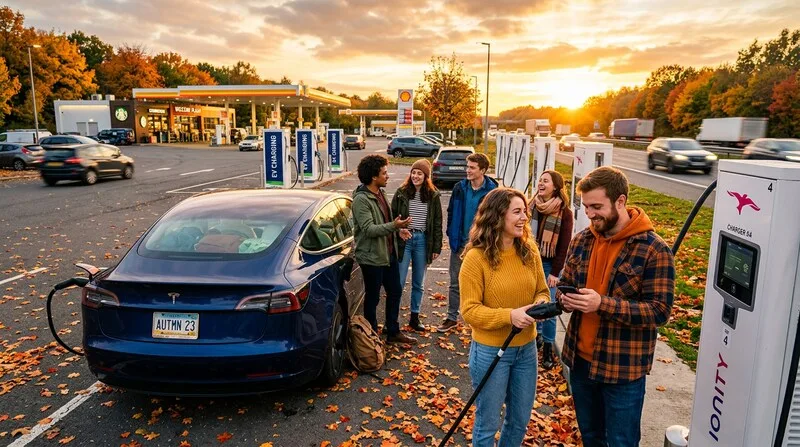
This is the most important rule, especially at DC fast chargers. When your EV reaches its target charge — whether 80% or 100% — move it as soon as reasonably possible. Most charging networks charge idle fees (typically $0.40–1.00 per minute) after a session ends and the vehicle remains connected, which is both a financial incentive and a signal that occupying a stall after charging is a problem.
At Level 2 destination chargers (hotels, parking garages), the expectation is somewhat more relaxed — these are designed for multi-hour stays. But at fast chargers on a busy highway corridor, leaving your car for 30 minutes after it finishes charging while others queue is genuinely inconsiderate.
Practical tip: Set a notification in your EV app or the charging network app to alert you when charging completes. Most apps support this — use it.
Stop at 80% If Others Are Waiting
DC fast chargers slow down significantly above 80% state of charge as the battery management system tapers current to protect cells. The last 20% of charge takes nearly as long as the first 80%. When chargers are occupied and other drivers are waiting, stopping at 80% and moving on is both faster for you and far more considerate for the queue.
Most EVs allow you to set a charge limit directly in the car's interface or through the charging network app. For road trips, 80% is almost always sufficient to reach the next charging stop anyway.
Never Unplug Someone Else's EV

Unplugging another person's EV without their permission — even if their session appears finished — is considered a serious breach of EV etiquette and may be illegal in some jurisdictions. There are legitimate reasons a car may appear "done" but the driver has not yet returned. If you genuinely need that stall urgently, check the app for the session status and see if the network has a feature to notify the owner. Do not touch the cable.
ICE-ing: What It Is and What To Do
"ICE-ing" refers to an Internal Combustion Engine (ICE) vehicle parking in an EV charging bay, blocking access to the charger. It ranges from innocent ignorance (the driver did not notice the markings) to deliberate harassment. It is a growing problem at high-traffic charging locations.
What to do if a bay is ICE-d:
- Check if there is a secondary stall with a cable long enough to reach around the blocking vehicle
- Report it through the charging network app — many apps allow you to flag a blocked station
- Contact the property manager or security if at a shopping center or parking facility
- In most US states, EV-only parking is legally enforced — you can call for a parking violation or tow in appropriate circumstances
- Do not confront the vehicle owner aggressively
Cable Etiquette
When you finish charging, return the cable to its holster or hang it neatly. A cable left on the ground is a trip hazard and, in wet conditions, a safety concern. At stations where cables are fixed to the unit (most DC fast chargers), plug it back in properly. At stations with trailing cables (some Level 2 units), coil or hang the cable so the next user does not have to manage a tangled mess.
Camping at Free Level 2 Chargers
Some supermarkets, shopping centers, and destination locations offer free Level 2 charging as a customer amenity. Using these chargers while shopping is exactly their intended purpose. Leaving your car on a free Level 2 charger for 6 hours while you work nearby — when you live locally and have home charging — monopolizes a community resource. The informal rule: free destination chargers are for customers and travelers, not as a permanent substitute for home charging you choose not to install.
Reporting Broken Chargers
If you find a charger that is broken, out of service, or displaying an error, take 30 seconds to report it — either through the network app or via the customer service number printed on the unit. PlugShare community check-ins are especially valuable here: a quick check-in noting "charger offline" saves the next person from driving to a station that will not work. The EV community runs partly on this kind of informal infrastructure.
The Simple Summary
- Move your car when charged — do not occupy a stall you are no longer using
- Stop at 80% at fast chargers when others are waiting
- Never unplug someone else's vehicle
- Report ICE-ing to the property manager, not through confrontation
- Return cables neatly after use
- Report broken chargers so others benefit from the information
None of these rules are formally codified, but the EV community has converged on them organically because they make shared infrastructure work better for everyone. Follow them and you will be a considerate part of the charging ecosystem from your first week as an EV owner.