Tesla Opens Its Network: The Background
For most of Tesla's history, Superchargers were exclusive to Tesla vehicles — a major competitive advantage and a key selling point. That changed in 2022, when Tesla began opening Superchargers to non-Tesla vehicles in Europe under a pilot program. The US opening followed in 2023, starting with selected V3 Supercharger stations equipped with the Magic Dock — a built-in CCS1 adapter that allows non-NACS vehicles to plug in.
The network opening accelerated significantly in 2024 and 2025 as the industry converged on NACS. Vehicles equipped with a native NACS port (Ford, GM, Rivian, Honda, and others from 2024+) can plug directly into Superchargers without any adapter. For CCS1 vehicles, Magic Dock stations remain the access point.
Two Ways Non-Tesla EVs Can Use Superchargers
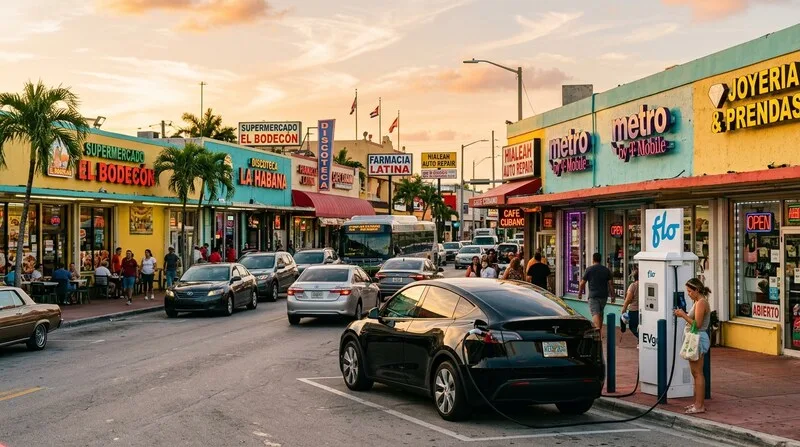
The method depends on your car's connector:
- NACS-equipped vehicles (2024+ Ford, GM, Rivian, Honda, etc.): Plug the Supercharger cable directly into your car's NACS port. No adapter needed. Use the Tesla app or a credit card at V4 stations to start the session.
- CCS1 vehicles (Hyundai, Kia, BMW, older VW, Chevy Bolt, etc.): You need a Magic Dock station. These Superchargers have a built-in adapter that flips out from the charging pedestal. You still need the Tesla app (free to download) and a payment method on file.
How to Set Up and Pay
- Download the free Tesla app and create a Tesla account
- Add a credit card to your Tesla account (required for non-Tesla charging)
- At the station, scan the QR code or open the Tesla app → Charging → Scan to charge
- Select your stall number and start the session
- For CCS1 vehicles at Magic Dock stations: locate the Magic Dock adapter on the pedestal, flip it out, and connect to your car's CCS1 port
Some newer V4 Supercharger stations have credit card readers built into the pedestal — non-Tesla drivers can start sessions without the app at these locations.
Pricing: What Non-Tesla Drivers Pay
Non-Tesla drivers do not get the same rates as Tesla owners. Pricing as of 2026:
| Customer Type | Typical Price | Notes |
|---|---|---|
| Tesla (no subscription) | $0.25–0.38/kWh | Varies by location and time |
| Non-Tesla (ad-hoc) | $0.44–0.55/kWh | Standard non-Tesla rate |
| Non-Tesla (Membership) | $0.35–0.45/kWh | $12.99/month membership discount |
Non-Tesla pricing is higher than what Tesla vehicle owners pay. Tesla has introduced a non-Tesla membership ($12.99/month) that provides a discount, but the break-even requires fairly frequent Supercharger use. For occasional use, paying the higher ad-hoc rate is reasonable.
Which Supercharger Stations Have Magic Dock?
Not all Supercharger stations offer Magic Dock access. As of 2026, approximately 4,000 Supercharger stalls in the US have Magic Dock capabilities — concentrated at V3 highway stations and urban V4 installations. Older V2 stations and many V3 stations in low-traffic areas have not been upgraded.
To find Magic Dock stations:
- In the Tesla app: use the Supercharger locator and filter by "CCS1 compatible"
- PlugShare: filter by NACS and check user reviews for Magic Dock confirmation
- The ChargeMap24 map: shows Supercharger stations accessible to non-Tesla vehicles
Tips for Non-Tesla Drivers at Superchargers
- Check in advance: Confirm the station has Magic Dock (for CCS1) or NACS compatibility before depending on it for a road trip
- Avoid peak times: Superchargers now serve a mix of Tesla and non-Tesla drivers; highway stations on holiday weekends can have queues
- Use the 10–80% rule: Charging is fastest between 10% and 80% state of charge — above 80%, charging speed drops significantly on all vehicles
- Download the app beforehand: Setting up your Tesla account and adding payment before arriving at the charger saves time and frustration
- Power sharing: Some stalls share power — if an adjacent stall is active, your speed may be lower. Try unpaired stalls (odd numbers: 1A, 2A, 3A) if possible