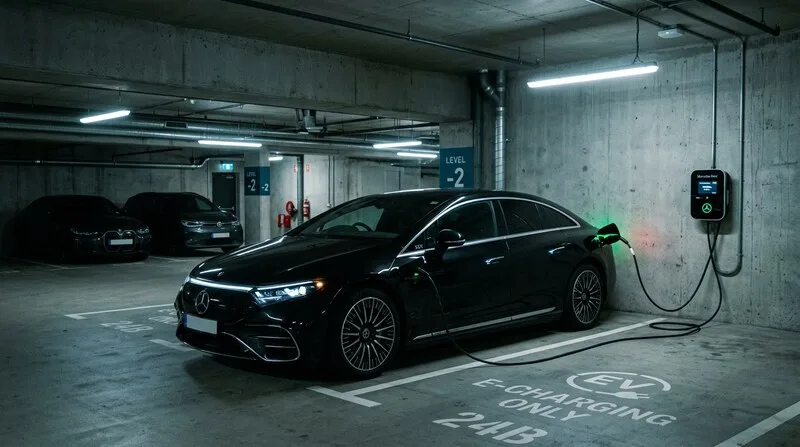
Lease or buy an EV? The honest breakdown
Leasing isn't buying – you pay only for use, and the vehicle stays owned by the leasing company. That comes with clear tradeoffs:
| Factor | Leasing | Buying |
|---|---|---|
| Monthly payment | Lower (just depreciation) | Higher (financing) or none |
| Ownership | No | Yes |
| Technology risk | Held by the leasing company | Held by the buyer |
| Tax treatment (business) | Payment fully deductible | Depreciated over 6 years |
| Mileage flexibility | Fixed, overage fees apply | Unlimited |
| Resale-value risk | None (usually) | Fully with the owner |
| Term | Typically 24–48 months | As long as you like |
Who should lease? Anyone who wants a new model every 2–3 years, wants to avoid resale-value risk (EV long-term values are still less predictable than gas cars), and either uses the car for business (real tax savings) or doesn't want to tie up cash in a purchase.
Who should buy? Anyone keeping the car long-term (5+ years), driving high annual mileage, wanting no mileage restrictions, and with the cash available.
Personal leasing: who does it make sense for?

With a personal lease, you pay a fixed monthly amount and return the car at the end of the term. The rate depends on the vehicle price, term length, annual mileage, and residual value. Typical terms: 24–36 months, 6,000–9,000 miles/year.
Important: personal leases don't come with tax advantages. You can't deduct the payment or insurance. For most private individuals, leasing works out more expensive than financing a purchase – unless the manufacturer is subsidizing the lease heavily through a promotional offer.
- Check the effective annual interest rate (often 4–7%) – it's baked into the monthly payment
- Excess-mileage fees run 5–15 cents per mile – that adds up fast
- Return condition: scratches, worn tires, or dents can get expensive
- Full coverage insurance is usually mandatory: adds €50–150/month to your costs
Cheapest entry point: Volkswagen, Renault and Stellantis brands (Fiat, Peugeot, Opel) regularly run subsidized lease deals under €200/month, usually on their smaller models.
Business leasing: real tax advantages
Business leasing is significantly cheaper once you factor in the tax effects. The lease payment is 100% deductible as a business expense. At a 30% tax rate, a €500 payment effectively costs just €350 net.
On top of that comes the biggest EV-specific perk in Germany: the 0.25% company-car rule. Instead of taxing 1% of the gross list price monthly as a taxable benefit, EVs are taxed on just 0.25%:
| Vehicle (€45,000 list price) | Taxable benefit/mo. | Tax/mo. (40% bracket) |
|---|---|---|
| Gas car (1% rule) | €450 | €180 |
| EV (0.25% rule) | €112.50 | €45 |
| Monthly savings | €337.50 | €135 less tax |
Full tax details: EV taxation: the 0.25% rule and company cars explained. There are also tax perks for a home charger: Home EV charger incentives 2026.
The cheapest EVs to lease in 2026

These models regularly show up with attractive lease offers (indicative personal-lease terms, 24 months, 6,000 miles/year, no down payment – actual pricing varies a lot by dealer and promotion):
| Model | Battery / range | Lease from | Notable |
|---|---|---|---|
| Fiat 500e | 42 kWh / 199 mi | from €139/mo. | Cheapest entry point |
| Peugeot e-208 | 54 kWh / 249 mi | from €159/mo. | Great for city + commuting |
| Renault Megane E-Tech | 60 kWh / 292 mi | from €199/mo. | Strong lease incentives |
| VW ID.3 Pro | 58 kWh / 267 mi | from €229/mo. | Well-known brand, wide dealer network |
| Hyundai IONIQ 6 | 77 kWh / 381 mi | from €299/mo. | Best efficiency, 800V charging |
| Tesla Model 3 | 75 kWh / 391 mi | from €319/mo. | Supercharger network included |
| BMW i4 eDrive40 | 82 kWh / 367 mi | from €449/mo. | Premium, strong company-car terms |
| Mercedes EQC | 80 kWh / 286 mi | from €499/mo. | Prestige, high list price for the 0.25% rule |
Note: rates are indicative – actual offers depend heavily on dealer, region, down payment and promotions. Business rates typically run 15–25% below personal-lease pricing.
Plan your charging: use the charging time calculator to see how long a public charging session will take. Find every charging station on the interactive map.
What to check in your lease contract
These details are frequently overlooked and can get expensive:
- Plan your mileage allowance realistically: when in doubt, budget an extra couple thousand miles. Excess-mileage fees (5–15 cents/mile) add up fast to €300–500 extra.
- Be cautious with a down payment: it's not automatically a "better deal" – a down payment lowers the monthly rate but increases your financial exposure if the car is totaled or stolen.
- Check for gap insurance: if the car is totaled, standard insurance only pays out its current market value, while the lease contract requires the contractual residual value. Gap insurance covers the difference – sometimes included, sometimes an add-on.
- Read the return conditions carefully: what counts as "normal wear"? Usually: minor scuffs under an inch without rust are fine, anything beyond that gets costly. A professional pre-return inspection is worth the cost.
- Maintenance and tires: some contracts require service at an authorized dealer, others are flexible. Tires are usually the lessee's responsibility.
- EV-specific: battery health at return: some manufacturers check the battery's state of health at return. If it drops below roughly 70%, extra charges can apply. Avoid daily DC fast-charging to 100% to protect your standing.
Frequently asked questions
Can I get incentives on an EV I'm leasing?
Germany's national purchase bonus is gone since 2024. Business lessees can still deduct the lease payment as a business expense, though. A home charger can still be funded through KfW 442 or an employer benefit, regardless of whether you lease or buy.
Am I allowed to drive a leased car abroad?
Yes, generally within the EU. Outside the EU (Switzerland, the UK), you typically need to request export approval from the leasing company beforehand. Skipping that step can be treated as a contract violation.
What happens to my lease if I change jobs?
With an employer-provided company car lease, your right to use the car ends with the job. Some contracts allow the employee to take over the lease personally – that has to be spelled out in the contract. Personal leases stay tied to you individually.
When does leasing beat buying for an EV?
Leasing pays off especially for: (1) business use with real tax savings, (2) uncertainty about how fast battery technology is evolving, (3) limited annual mileage, and (4) wanting a new model regularly. For personal use, high mileage, and long-term ownership, buying is usually the cheaper path.
More cost factors: True cost of owning an EV 2026. Company-car tax details: EV taxation: the 0.25% rule explained · Germany's EV incentives 2026.