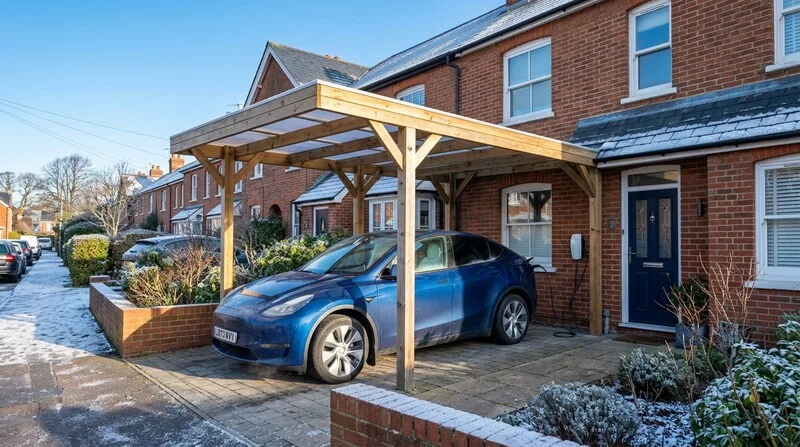
Why a wallbox instead of a regular outlet?
A standard household outlet delivers at most 2.3 kW – a 60 kWh battery would take over 25 hours to fill from empty. An 11 kW home charger (commonly called a "wallbox" in Europe) charges the same battery in around 6 hours – comfortably overnight. On top of that, regular household outlets aren't built for sustained heavy loads and can overheat with frequent EV charging. A dedicated charger is safer, faster, and cheaper to run.
What power output do you actually need?
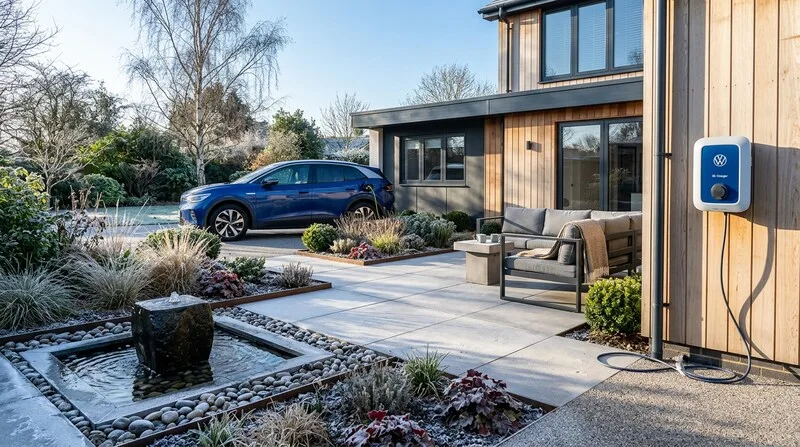
| Power | Charge time (60 kWh) | Best for |
|---|---|---|
| 3.7 kW (single-phase) | ~16 hours | PHEVs, rarely-driven EVs |
| 7.4 kW (single-phase) | ~8 hours | Good compromise, cheaper install |
| 11 kW (three-phase) | ~6 hours | Recommended for most |
| 22 kW (three-phase) | ~3 hours | Only if your car actually supports 22 kW AC (few do) |
Bottom line: an 11 kW home charger with a Type 2 connector is the sweet spot for most drivers. Very few current EVs can even use more than 11 kW of AC power.
What does installation actually cost?
Total cost breaks down into the unit itself plus installation:
- Basic 11 kW charger, no smart features: €300–600 (unit)
- Smart charger with app, load management, solar integration: €700–1,500 (unit)
- Electrician installation: €300–800 depending on cable run and complexity
- Fuse box upgrade (if needed): an extra €300–600
Realistic total: €800–2,500 including installation. Budget setups start around €800; premium setups with full energy management run €2,000–2,500.
Incentives: who helps pay for it?
Germany's KfW program
The nationwide KfW grant for private home chargers ran out of funding back in 2022 and hasn't been renewed. What's still active:
- KfW 261 (building efficiency renovation): a charger can be co-funded if it's part of a broader energy retrofit
- Tax benefit: employers can provide or subsidize a home charger completely tax-free for the employee
Regional programs in Germany
- Bavaria: up to €500 through the "BayernFonds E-Mobilität" program when combined with solar installation
- Baden-Württemberg: several municipalities run their own local incentive programs
- North Rhine-Westphalia: "progres.NRW" for businesses and housing associations
Grid operator incentives
Many German grid operators offer a smart-meter incentive for 11 kW chargers – up to €200 for integrating the unit into the smart grid.
Popular home charger models in 2026
- go-e Charger HOME FIX 11 kW: ~€450, compact, solid app – best value pick
- ABL eMH1: ~€350, rugged and dependable, no smart features
- Keba KeContact P30: ~€600, industrial-grade, extremely durable
- Wallbox Pulsar Plus 11 kW: ~€550, Bluetooth, strong app integration
- Tesla Wall Connector: ~€450, optimized for Tesla, works with other brands too
- Webasto Next: ~€480, good energy management
What you need before installation
- Electrical panel capacity: a 16A circuit per phase, ideally three-phase
- Grid operator registration: chargers above 3.7 kW must be registered with the local grid operator (free, but mandatory)
- Renting or living in a shared building? you'll need landlord or HOA sign-off – though German law has guaranteed tenants and co-owners a right to install a charger on their own parking spot since 2020
- Licensed electrician only: installation must be done by a certified electrical contractor
Frequently asked questions
Do renters need permission to install a home charger?
Yes, but German law reform in 2020 gave tenants and co-owners a legal right to approval for installing a charger on their own parking spot. Landlords can no longer refuse arbitrarily, though they can influence how the installation is carried out.
11 kW or 22 kW – which makes more sense?
11 kW is plenty for around 90% of drivers – most EVs can't use more than 11 kW of AC power anyway. 22 kW only helps if your specific vehicle supports it, and a 22 kW unit also requires separate grid operator approval.
Can I run a home charger on solar power?
Yes, and it's the cheapest way to charge. With smart energy management (SMA, Fronius, Victron and similar systems), the charger automatically ramps up when your solar system is producing surplus power, pushing your effective charging cost toward zero.
Find every public charging station on the charging map. Next up: Charging as a renter · Combining solar and home charging · Cheap home electricity for EV charging · Bidirectional charging (V2G)