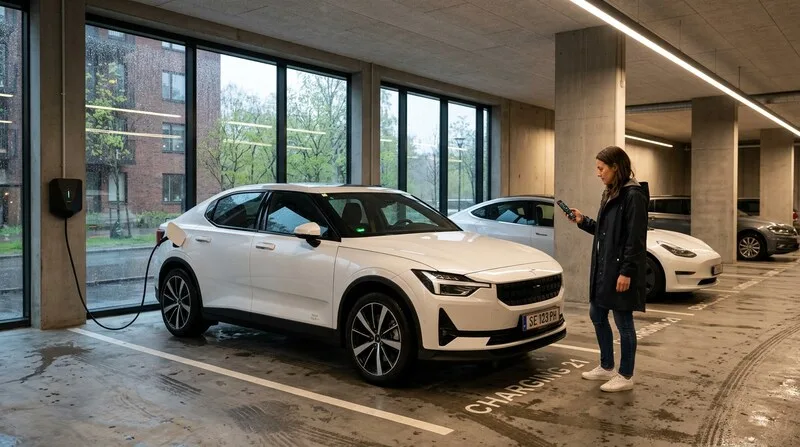
Why the electricity rate matters so much – and what it really costs
An EV driven 12,500 miles a year at 18 kWh/100km uses roughly 3,600 kWh a year. At a good rate (28 cents/kWh), that's €1,008. At an expensive default utility rate (38 cents/kWh), it's €1,368 – a difference of €360 a year, purely from switching plans.
On top of that: with a smart rate, you can charge specifically when electricity is cheap (overnight, or during high wind/solar generation). Squeeze that advantage fully and you can save another €100–200.
| Rate type | Price/kWh (approx.) | Charging cost/year (3,600 kWh) | Best for |
|---|---|---|---|
| Default utility rate | 35–42 cents | €1,260–1,512 | Not for EVs – too expensive |
| Regular green-power provider | 28–33 cents | €1,008–1,188 | A solid starting point |
| EV-specific fixed rate | 25–30 cents | €900–1,080 | EV drivers, simple setup |
| Dynamic rate (avg.) | 18–26 cents (avg.) | €648–936 | Smart charger owners, tech-savvy |
| Solar self-consumption | ~5 cents (system cost only) | ~€180 (self-consumed share) | Solar panel owners |
Compared to gasoline: at 8 l/100km and €1.75/liter, the same distance costs €2,800/year – an EV comes out well ahead even on a pricey electricity plan. Details: True cost of owning an EV 2026.
Tibber: the most popular dynamic rate for EV drivers
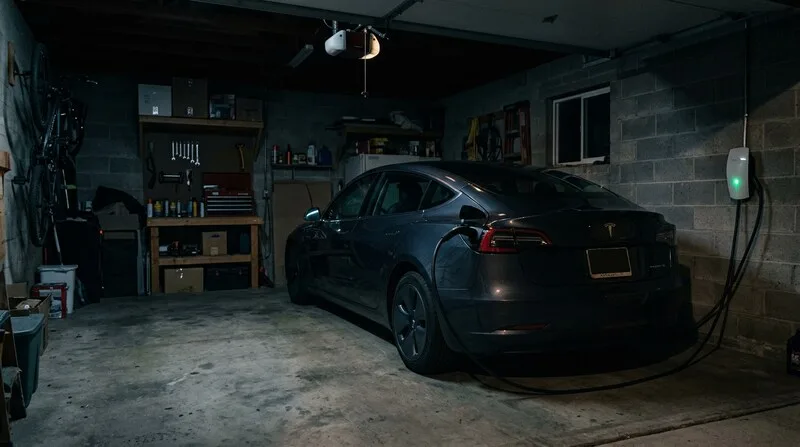
Tibber is a Norwegian electricity provider that sells power directly at the wholesale market price (EPEX Spot). Instead of a fixed rate, you pay anywhere from 5 to 60+ cents per kWh depending on the hour, plus a monthly base fee (from roughly €10/month).
How Tibber works:
- The app shows the current electricity price for every hour of the day
- It recommends the cheapest windows to charge
- With a compatible smart charger (go-e, KEBA P30, Easee and similar), charging starts automatically at the cheapest time
- Overnight between roughly 2am and 6am is often the cheapest window (sometimes under 10 cents/kWh)
Typical savings with Tibber: €200–400 a year versus a default utility rate, especially for households with higher overall electricity use (Tibber tends to pay off from roughly 3,000 kWh/year total consumption).
Requirement: a smart meter. Without one, hourly pricing isn't possible at all.
Octopus Energy, aWATTar and other dynamic providers compared
| Provider | Model | Base fee/mo. | Avg. rate 2024 | EV integration |
|---|---|---|---|---|
| Tibber | Spot (hourly) | €10.90 | ~20–24¢ | App + charger control |
| Octopus Energy | Spot (hourly) | €9.50 | ~20–25¢ | App + charger prioritization |
| aWATTar | Spot (15-min) | €4.90 | ~20–24¢ | Home energy management compatible |
| EnBW mobility+ Flex | Partly variable | €6.90 | ~25–30¢ | EnBW ecosystem, incl. public charging |
| E.ON Fixed Rate | Fixed price | €8.90 | ~28–32¢ | No automatic control |
| Local utility EV rate | Fixed (specialized) | varies | ~26–30¢ | Often local charger perks |
Recommendation: with a smart charger → Tibber or aWATTar. Without a smart charger → the cheapest fixed-rate green-power provider you can find on a comparison site. Many local utilities now offer dedicated EV rates too – worth checking.
Off-peak flat rate vs. dynamic rate: which is better?

The old-school approach was a dual-meter setup with an off-peak flat rate (cheaper power at night, pricier during the day). That model is gradually being replaced by dynamic rates:
- Off-peak flat rate: fixed hours (e.g. 10pm–6am), fixed price around 22–28 cents. No smart meter needed, but rigid.
- Dynamic rate: price changes hourly with the wholesale market. Under 10 cents in good hours, over 35 cents in bad ones. Smart meter required, a smart charger strongly recommended.
- Combined with solar: a dynamic rate makes particular sense alongside a solar system – charge cheaply whenever there's surplus. Details: Pairing solar with a home charger.
Rule of thumb: if you have a smart charger or a home energy management system, switching to a dynamic rate generally pays off above roughly 4,000 kWh/year total household electricity use.
Checklist: finding the right rate for your EV
- Do you have a smart meter? If yes, check dynamic rates (Tibber, Octopus, aWATTar). If not, find the cheapest fixed-rate green-power plan through a comparison site.
- Do you have a smart charger? go-e, KEBA, Easee and Fronius Wattpilot are Tibber-compatible. Without one, you'll need to time charging manually.
- Do you have solar panels? Solar-surplus charging takes priority, supplemented by a dynamic rate for nighttime charging. Details: Solar + home charger guide.
- How many miles a year do you drive? Under 6,000 miles: any savings will be modest. Over 12,000 miles: finding the right rate matters a lot more.
- Does your employer reimburse charging? If they cover a flat €30/month tax-free, your effective charging cost is close to zero. Details: EV tax advantages explained.
Find public charging when you're on the road: Charging map.
Frequently asked questions
Do I need a special rate to charge at home?
No, you can charge your EV on any standard household electricity rate. But a cheaper plan saves €100–400 a year depending on how much you drive. A dedicated EV rate or dynamic tariff is worth it once you charge at home regularly.
Is Tibber worth it without a smart charger?
Yes, but you'll save less. Without a smart charger, you have to manually start charging when the price is low. With one, Tibber automatically starts charging at the cheapest time – maximizing savings with zero effort.
What does a smart meter cost for dynamic rates?
Under Germany's 2023 smart-meter rollout law, smart meters are mandatory for households using over 6,000 kWh/year, with the grid operator covering the cost (capped at roughly €20/year in rental fees). Households with a home charger or solar system are often prioritized in the rollout.
Is there a special rate just for public charging?
Yes: charging cards like ADAC e-Charge, Plugsurfing Premium or EnBW mobility+ offer cheaper per-kWh pricing at public stations. Frequent public chargers save 30–50% versus the ad-hoc rate with a card. More on the charging map.
Minimize your charging costs: Free EV charging – where and how. Total cost check: True cost of owning an EV 2026 · EVs for commuters.