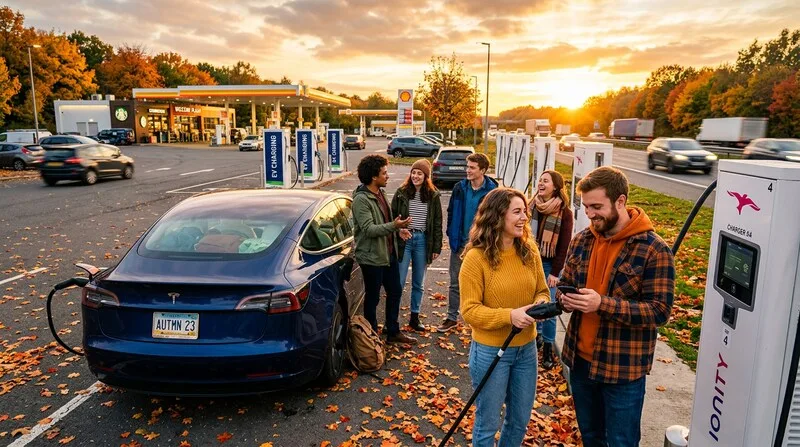
Charging infrastructure on German highways in 2026
Germany has over 8,700 miles of highway (Autobahn). Fast-charger coverage (50+ kW) is solid on the main corridors and still has some gaps on secondary routes. The key players:
Ionity – the highway fast-charging network
Ionity is a joint venture between major automakers (BMW, Mercedes, Ford, the VW Group) and runs the densest 350 kW network along German highways, almost always right at rest stops.
- Power: up to 350 kW per stall (CCS)
- Price without a plan: €0.79/kWh – expensive
- With an ADAC partner plan: €0.35/kWh – huge savings potential
- Spacing: roughly every 90–125 miles on main corridors
- In Germany: about 250 sites with 4–12 stalls each
Tesla Supercharger
Tesla has placed its network strategically at highway exits, shopping centers and hotels. Open to all brands since 2022. One advantage for Tesla drivers: automatic route planning with charging stops built in.
- Power: V3 at 250 kW, V4 at 350 kW
- Very high reliability
- In Germany: 700+ sites, many right off the highway
Full guide: Tesla Superchargers in Germany.
EnBW HyperNetwork
EnBW runs Germany's largest fast-charging network by number of sites, particularly strong in Baden-Württemberg and along the A8, A5 and A81.
- Power: up to 300 kW at HPC stations
- With the mobility+ plan: from €0.10/min AC, from €0.44/kWh DC
- Sites: 2,500+ across Germany, 500+ directly at highway rest stops
Autobahn GmbH – the federal rest-stop network
Germany's federal highway authority is rolling out legally mandated charging infrastructure. By 2026, all 360 federal rest stops are supposed to have at least 4 high-power charging points.
- 2026 status: roughly 180 rest stops already have fast chargers
- Multiple operators (Aral pulse, EnBW, Allego)
- Pricing: market rates, no government price cap
How to plan a stress-free road trip
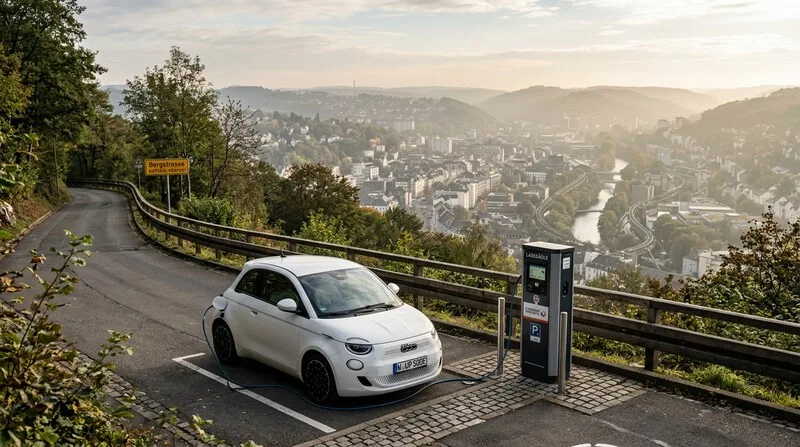
- Use a route-planning app: ABRP (A Better Route Planner), Google Maps (shows chargers), or your automaker's built-in nav
- Charge at 20%, not 5%: don't wait until the battery is nearly empty – it also charges better while still somewhat warm
- Activate preconditioning: 15–20 minutes before you arrive noticeably boosts DC charging speed
- Charge to 80%, not 100%: the charging curve drops off sharply past 80% – it's usually faster overall to drive on and stop again than to wait it out
- Treat the stop as a break: 20–25 minutes at a 150+ kW charger adds roughly 125 miles of range – enough time to stretch your legs
- Know your backup: always have a second charging location nearby in your app
When does highway charging infrastructure get crowded?
The start of school holidays and long weekends bring queues at popular Ionity stations. A few tips:
- Leave early (before 8am) or later in the evening (after 8pm) around holiday starts
- Consider chargers 2–3 miles off the highway – often empty and cheaper
- The Ionity app shows real-time occupancy
Cost comparison: highway charging networks
| Network | Ad-hoc price | With a plan | Max power |
|---|---|---|---|
| Ionity | €0.79/kWh | from €0.35/kWh (ADAC) | 350 kW |
| Tesla V3 | €0.52/kWh | — | 250 kW |
| EnBW HPC | €0.59/kWh | from €0.44/kWh (plan) | 300 kW |
| Aral pulse | €0.10/min | Capped at €12/day | 150–300 kW |
Route-planning apps that actually work
The right tool is the difference between a relaxed road trip and unnecessary range anxiety. Here's what serious EV drivers actually use:
- ABRP (A Better Route Planner): the best third-party app. Factors in your specific vehicle, state of charge, weather and elevation. Route planning pulls live data from OpenChargeMap and direct network feeds.
- Manufacturer navigation (Tesla, VW ID, BMW): the tightest integration for your specific model – Tesla's nav automatically plans Supercharger stops with preconditioning built in.
- Google Maps: shows chargers as points of interest, but doesn't optimize routing around your battery level.
- Chargeway: solid for cross-border European trips, shows live pricing.
Tip: set up your vehicle profile in ABRP (starting charge, target charge) and it will consistently outperform many built-in nav systems. It's free to use, with a premium tier (around $4/month) adding live occupancy data. For charging without an app or card at all, see our ad-hoc charging guide.
Preconditioning: getting maximum charging power
Plenty of EV drivers run into this: the car only charges at half power at the plug. The most common cause is a battery that's too cold. The fix is battery preconditioning.
The car heats or cools the battery to its ideal charging temperature (roughly 77–95°F/25–35°C) before you arrive. Result: full charging speed from the first second, instead of a slow ramp-up over the first 10 minutes.
| Vehicle | Preconditioning | How to activate |
|---|---|---|
| Tesla | Automatic when navigating to a Supercharger | Set nav destination to a Supercharger |
| VW ID.4 / ID.3 | Triggers when navigating to a fast charger | Set the charger as your nav destination |
| BMW iX / i4 | Manual activation via the iDrive menu | Settings → Charging |
| Hyundai IONIQ 6 | Automatic when navigating to a fast charger | Set a DC station as your destination |
Important: preconditioning uses some battery energy, so start it at least 15–20 minutes before arrival. In winter, the difference can mean 30–50% more charging power. More on that: EV range in cold weather.
Frequently asked questions
How often do I need to charge on a 400-mile trip?
With a car rated for 250 miles and winter conditions (roughly 175 miles real-world), expect 1–2 stops. In summer with a larger battery and highway speeds around 75 mph, often just one stop is needed. ABRP or your manufacturer's nav can plan this precisely.
Which charging card is worth it for highway driving?
For frequent road-trippers, a combo approach makes sense: an ADAC card (cheap Ionity access) plus an EnBW plan plus the Tesla app. If you mostly drive a Tesla, the Tesla app alone covers you. More: Charging card comparison.
What if the charger is broken when I arrive?
Always have a backup planned: ABRP shows alternative chargers within a few miles. Downtime at Ionity, Tesla and EnBW sites runs under 2%. At less established operators, budget for up to 10% downtime.
Find every fast charger on the charging map (150+ kW filter). Compare pricing: Full charging guide with pricing.