What makes the Supercharger network stand out?
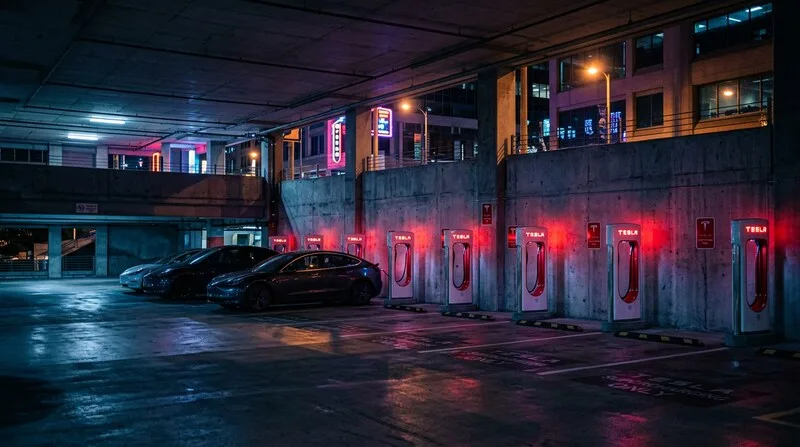
The Tesla Supercharger network is widely considered one of the most reliable fast-charging systems in the world. Germany alone has over 700 sites with more than 7,000 charging stalls (2026 figures). What sets it apart:
- Reliability: internal data puts the downtime rate below 1%
- Location quality: stations sit at strategic spots – highways, shopping centers, hotels
- Preconditioning: Tesla vehicles automatically warm the battery before arrival, maximizing charging speed
- Built-in navigation: the car's own nav system plans your charging stop automatically
V2, V3, V4 – generations compared
| Generation | Max Power | Notable feature |
|---|---|---|
| V2 (from 2016) | 72–150 kW | Power shared between paired stalls |
| V3 (from 2019) | 250 kW | No power sharing, 1,000V architecture |
| V4 (from 2023) | 350 kW | Magic Dock for non-Tesla EVs, longer cable |
At a V3 Supercharger, a Tesla Model 3 Long Range goes from 10–80% in about 15 minutes – roughly 150 miles of range added during a coffee break.
2026 pricing: what does it actually cost?
Prices vary by location and time of day (peak hours cost more). As a Tesla owner without a membership plan:
- Ad-hoc, no plan: roughly €0.52–0.62/kWh
- With a Tesla charging credit: often bundled with vehicle purchase
- Non-Tesla drivers: roughly €0.55–0.70/kWh plus a one-time €2 session fee
For a 60 kWh battery (0–80%), that puts a non-Tesla driver's bill at roughly €28–34 per session. Depending on your car, alternative networks like EnBW or Ionity with a partner plan can work out cheaper.
Superchargers for non-Tesla EVs

Since November 2022, Tesla has been gradually opening the network to other brands. Most German Superchargers are now accessible. What you need:
- A vehicle with a CCS port
- The Tesla app, with an account set up
- A credit card on file for payment in-app
- At a V4 stall: the Magic Dock adapter is already built in – no adapter needed
- At a V3 stall: you'll need your own Type 2-to-CCS adapter (not sold for every vehicle)
One caveat: non-Tesla vehicles usually receive slightly less power than a Tesla charging at the same stall.
Finding a Supercharger
The charging map with a Tesla filter shows every Supercharger in Germany at a glance, along with real-time occupancy where available.
Frequently asked questions
Can non-Tesla drivers use every Supercharger?
Almost all German Superchargers are now open to other brands. The Tesla app shows whether a specific location is available. At V4 stalls, no extra adapter is needed.
Why is charging more expensive for non-Tesla drivers?
Tesla charges a roughly €2 session fee and a slightly higher per-kWh rate to other brands. The network was originally built for Tesla owners, and this is how Tesla recoups part of that investment.
Are there waiting lines at Tesla Superchargers?
At busy locations (highway rest stops, weekends), yes. The app and in-car nav show current occupancy and queue length. Newer V4 sites often have 8–16 stalls, meaning shorter waits than older V2/V3 sites with just 4–8.
More on Tesla charging: Tesla charging costs 2026 · Highway charging guide · Charging card comparison · Find all charging stations