Why bother with a charging card at all?
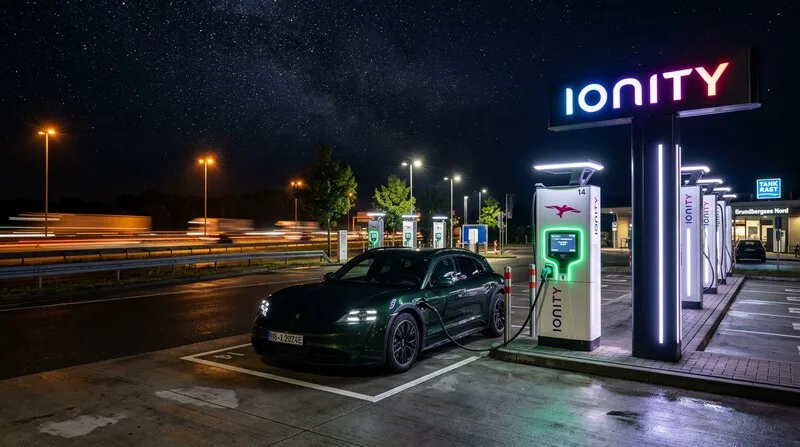
Charge at a public fast charger with no card or plan, and you pay the ad-hoc price – often 50–120% more than with a decent plan. Take Ionity: €0.79/kWh with no card versus €0.35/kWh with an ADAC card. At 6,000 miles a year (roughly 18 kWh/100 km, half charged in public), that's up to €400 in savings annually.
The major charging cards in 2026, compared
ADAC e-Charge Card
One of the best options for frequent drivers who rely on Ionity:
- Base fee: €0 (requires ADAC membership, from €49/year)
- Ionity: €0.35/kWh (versus €0.79 ad-hoc)
- AC charging: €0.09/min
- Network: 400,000+ charge points across Europe
- Best for: ADAC members, frequent highway drivers
EnBW mobility+
Germany's most-used charging card, backed by the country's largest domestic network:
- Base fee: €0 (Basic plan) or €4.99/month (Smart plan, cheaper per kWh)
- DC charging (Basic): €0.59/kWh ad-hoc, €0.52/kWh with the card
- DC charging (Smart): from €0.44/kWh
- Notable: runs its own HyperNetwork of 300 kW stations
- Best for: anyone charging frequently on the EnBW network (especially southern Germany)
Maingau EnergyFlat
- Base fee: €4.99/month
- AC charging: €0.39/kWh (all networks)
- DC charging: €0.49/kWh (all networks)
- Notable: one flat price across 450,000+ charge points in Europe
- Best for: drivers who want simplicity across many different networks
Plugsurfing
- Base fee: €0 (free plan)
- Pricing: varies by network, usually 5–10% below market rate
- Bonus: often €20–30 in sign-up credit for new customers
- Network: 400,000+ charge points across Europe
- Best for: occasional chargers who want to stay flexible
Shell Recharge
- Base fee: €0
- Pricing: from €0.45/kWh DC
- Notable: integrates neatly with the Shell fuel station app
- Best for: drivers who frequently pass Shell stations
Direct comparison: 6,000 miles/year example
Assumptions: roughly 18 kWh/100 km, 30% public DC fast charging, 20% public AC, 50% home charging
| Charging card | Annual fee | DC+AC costs | Total |
|---|---|---|---|
| No card (ad-hoc) | €0 | ~€415 | ~€415 |
| ADAC e-Charge | €49 (membership) | ~€195 | ~€244 |
| EnBW Smart | €60 | ~€220 | ~€280 |
| Maingau Flat | €60 | ~€235 | ~€295 |
Savings, ADAC vs. no plan: roughly €171/year – the card pays for itself past roughly 25,000 miles a year (membership fee included).
Which card fits your driving profile?
- Frequent highway driver: ADAC e-Charge – the Ionity pricing beats everything else
- Southern Germany / commuting: EnBW mobility+ Smart
- Occasional charger / new to EVs: Plugsurfing (no base fee, sign-up bonus)
- Cross-border European trips: Maingau Flat or ADAC
- Tesla driver: the Tesla app alone is enough for the Supercharger network
EU rule: card payment at chargers since 2024
Since April 2024, EU law requires contactless card payment at public fast chargers rated 50 kW or above. New and retrofitted high-power stations must accept Visa/Mastercard contactless directly at the terminal – no app or account required.
- What's covered: all new DC fast chargers from 50 kW (under the EU's AFIR regulation)
- Grandfathering: older stations have a transition period through 2027
- In practice: Ionity, EnBW HPC and Aral pulse already largely support card payment
- The catch: ad-hoc card payment is often 20–40% more expensive than using a plan
Charging cards for company cars
Driving an EV as a company car adds requirements: charging sessions need to be billable, personal and business use need to be separated, and the employer needs an easy way to reimburse costs.
- EnBW mobility+ Business: monthly consolidated billing, itemized per session
- ChargePoint Business: fleet solutions with cost-center allocation
- Employer-provided charging: tax-free under German rules
Frequently asked questions
Can I use multiple charging cards at once?
Yes, and plenty of experienced drivers do exactly that: ADAC for Ionity, EnBW for the home network, plus a free card for everything else. The admin overhead is minimal, and the savings can be significant.
How do you pay without a charging card?
At modern chargers, usually by credit card directly at the terminal (contactless), via an app, or by scanning a QR code. Tap-to-pay with a phone is increasingly supported too.
Is roaming across networks worth it?
Roaming cards (one card, every network) are convenient but often pricier than dedicated network plans. Great for occasional charging, less ideal for high-mileage drivers who should pick network-specific plans instead.
Find every charging station on the charging map. Next up: Highway charging guide · Ad-hoc charging without a card · Cheap home electricity for EV charging