Charging time calculator
Enter your car's numbers and get the charging time and cost instantly:
Typical charging times at a glance
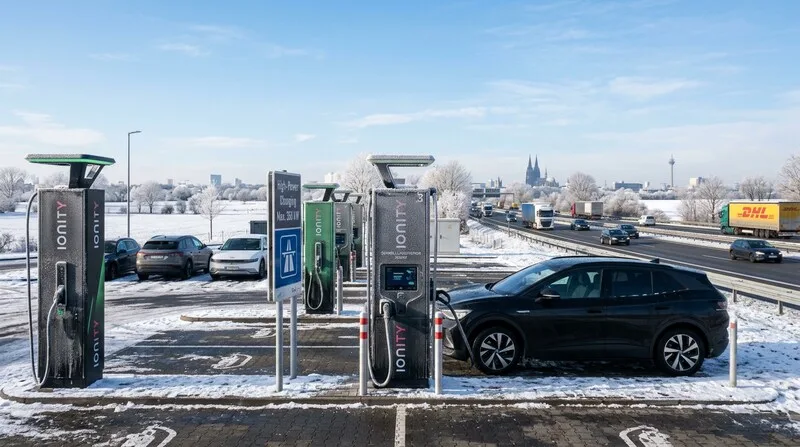
This table shows how long a full charging session takes (20→80%) for common battery sizes:
| Charging type | 60 kWh battery | 77 kWh battery | 100 kWh battery | Typical use |
|---|---|---|---|---|
| Wall outlet 3.7 kW | 9.8 hrs | 12.5 hrs | 16 hrs | Emergency/camping |
| Home charger 11 kW | 3.3 hrs | 4.2 hrs | 5.5 hrs | Home overnight |
| Home charger 22 kW | 1.6 hrs | 2.1 hrs | 2.7 hrs | Home/work |
| DC 50 kW | 43 min | 55 min | 72 min | City/shopping |
| DC 100 kW | 24 min | 31 min | 40 min | Highway rest stop |
| DC 150 kW | 19 min | 24 min | 31 min | Highway EnBW/Aral |
| DC 250 kW (Supercharger V3) | 13 min | 16 min | 22 min | Tesla Supercharger |
| DC 350 kW (Ionity) | 10 min* | 13 min* | 17 min* | Ionity, few vehicles |
* 350 kW can only be reached if the vehicle itself supports that peak rate (e.g. Hyundai IONIQ 6: 233 kW, Porsche Taycan: 270 kW). Most vehicles charge below 150 kW.
Find every fast charger near you on the charging map's DC filter.
Why does DC charging slow down after 80%?
The battery management system (BMS) deliberately throttles charging power once the battery hits 80%. The reason: lithium-ion cells degrade faster chemically when charged hard above that point. Past 80%, charging power drops to 30–50% of the peak rate.
- For daily driving: charge to 80% – the last 20% often takes as long as the first 80%
- For road trips: charge to 90–95% and keep driving, rather than waiting for 100%
- Preconditioning: Tesla, Hyundai and Porsche automatically warm or cool the battery before charging, which boosts peak charging speed
More on the difference between fast and slow charging: AC vs DC charging – which one when?
Charging times in winter
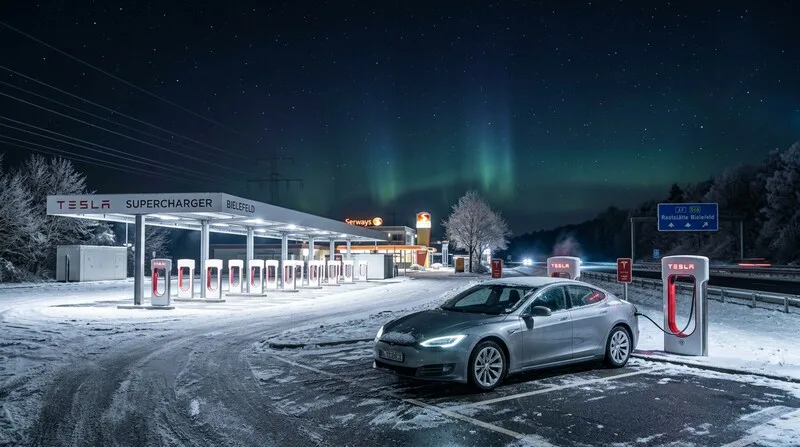
Winter extends charging time for two reasons:
- A colder battery: lithium-ion cells accept significantly less power below 50°F. Charging speed can drop by half.
- Preconditioning takes longer: the battery needs to reach operating temperature before fast charging is even possible.
Rule of thumb: at 23°F, expect 40–60% longer charging time for DC fast charging. AC charging at 11 kW is less affected, since the power level is already modest.
Tips for winter charging: EV range in cold weather.
Frequently asked questions
How long does charging from 0 to 100% take?
At an 11 kW home charger (VW ID.4, 77 kWh): about 7 hours. At a 50 kW DC charger: about 2.5 hours. At a 250 kW Tesla Supercharger: about 30 minutes. Charging fully to 100% is slower than 0–80%, since the BMS throttles power past 80%.
Can I charge faster than my car allows?
No. The vehicle itself caps the maximum charging rate. If your car maxes out at 50 kW DC, a 350 kW charger won't save any time – you'll still charge at 50 kW. Whichever number is lower, the car's limit or the charger's output, is what applies.
Does frequent fast charging damage the battery?
Occasional DC fast charging barely affects the battery. Charging to 100% via DC every single day, on the other hand, can shorten its lifespan. Best practice: charge to 80% at home daily, and save DC fast charging for road trips. Modern EVs protect their batteries with an intelligent BMS.
Find charging stations: Interactive map · AC vs DC charging · Choosing a charging cable · Optimizing energy consumption · EV range 2026