Home charging vs public charging
Most EV owners do 80–90% of their charging at home – either through a home charger (wallbox) at 11 kW (roughly 8–10 hours for a 60 kWh battery) or, in a pinch, from a regular household outlet (2.3 kW, painfully slow, emergency use only). Public charging stations are what make longer trips and life without a driveway possible.
AC charging vs DC fast charging
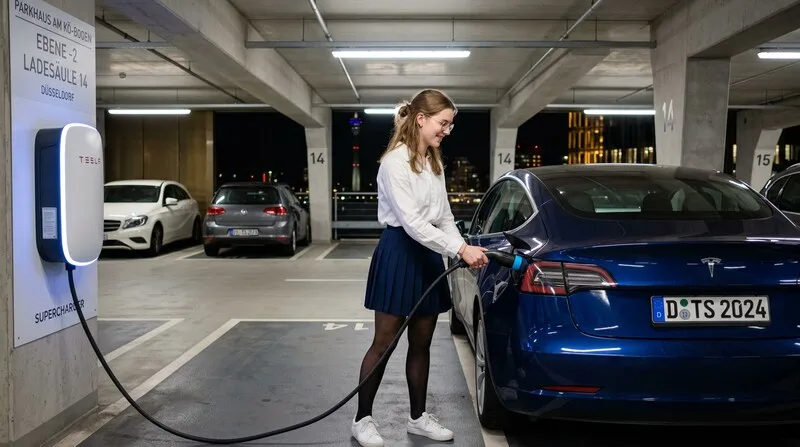
There are two fundamentally different ways to put electrons into your battery:
| Factor | AC Charging | DC Fast Charging |
|---|---|---|
| Power | 3.7–22 kW | 50–350 kW |
| Typical connector | Type 2 (Europe) / J1772 (US) | CCS, CHAdeMO, NACS |
| Time (60 kWh battery) | 3–16 hours | 15–60 minutes |
| Best for | Home, work, overnight parking | Highways, road trips |
Rule of thumb: AC charging is cheaper and easier on the battery. DC fast charging saves time but costs more, and shouldn't become your daily habit above 80%.
What does a charge actually cost?
Pricing depends heavily on the network and whether you're on a membership plan. As a rough guide in 2026:
- Home charging (US average): $0.10–0.18/kWh residential electricity rate
- Home charging (Europe average): €0.28–0.38/kWh
- Tesla Supercharger: roughly $0.25–0.48/kWh in the US, €0.40–0.52/kWh in Europe
- Ionity (Europe, no plan): €0.79/kWh – drops to around €0.35/kWh with a partner plan (e.g. ADAC)
- Free charging: some supermarkets, IKEA and hotels still offer it – see our guide to free charging in Germany
Tip: a solid charging card or app subscription (Plugsurfing, ChargePoint, EnBW mobility+) typically saves 30–50% versus paying ad-hoc at the plug.
How long will it actually take?
Charging speed comes down to three things: battery size, your car's maximum charging power, and the charger's output. Whichever of the three is weakest sets the pace – there's no way around it.
- VW ID.3 (58 kWh, 100 kW DC max): 10–80% in about 35 minutes
- Tesla Model 3 (75 kWh, 250 kW max): 10–80% in about 25 minutes
- BMW iX (111 kWh, 200 kW max): 10–80% in about 35 minutes
- Older/smaller EVs (50 kW DC max): 10–80% in roughly an hour
The major charging networks
In the US, the biggest players are Tesla Supercharger (now open to most brands), Electrify America, ChargePoint and EVgo. In Europe, Ionity covers the highway network at up to 350 kW, EnBW runs the largest footprint in Germany, and Tesla has opened most of its European Superchargers to all brands too. Find every option filtered by speed, network and connector on the interactive charging map.
7 tips for stress-free charging
- Never run below 10% – your battery (and your nerves) will thank you.
- Precondition before fast charging – warming the battery while driving to a charger noticeably speeds up the session.
- Know your charging curve – most EVs charge fastest between 20–80%.
- Charge while you shop – many supermarkets and retailers offer free or cheap AC charging.
- Use an app – Plugsurfing, ChargePoint or your automaker's app show real-time availability.
- Plan for seasonal range loss – cold weather can cut range by up to 30%.
- On the highway, charge at 10–20% – arriving low with the battery preconditioned gets you the fastest possible session.
Frequently asked questions
How long does it take to charge an EV?
At a fast charger (100+ kW), 10–80% typically takes 25–45 minutes. At a home wallbox (11 kW), a full charge on a 60 kWh battery takes around 6 hours.
Can I charge any EV at any charging station?
Not quite – connectors vary. Most European and newer American EVs use CCS for DC fast charging; Tesla uses NACS in the US and a modified Type 2/CCS setup in Europe; older Nissan Leafs use CHAdeMO. See our connector guide for the full breakdown.
Does frequent fast charging damage the battery?
Rarely in a meaningful way, but regularly charging to 100% via DC does slightly speed up aging. Best practice: keep DC sessions to a max of 80%, use full charges only before long trips.
Next up: EV connector types explained · Charging time calculator · Home charger installation · Find all charging stations