Solar + a home charger: the perfect combination
If you have solar panels and drive an EV, you can send self-generated electricity straight into the car – instead of selling it back to the grid for a few cents per kWh. That drops your effective charging cost close to zero and substantially raises your solar system's self-consumption rate.
Typical numbers: a 10 kWp solar system in Germany generates roughly 9,500–10,500 kWh a year. An EV driven 12,500 miles a year uses about 3,600 kWh (at 18 kWh/100km). That's roughly 35–40% of annual solar output – exactly what your car can absorb.
| Charging source | Cost/kWh | Carbon intensity | Recommendation |
|---|---|---|---|
| Solar surplus | ~€0.05 (system cost only) | ≈ 0 g/kWh | First choice – daytime |
| Home charging (night) | €0.28–0.35 | ~350 g/kWh | Cheap, predictable |
| Public AC charging | €0.35–0.55 | variable | On the go |
| Public DC fast charging | €0.49–0.79 | variable | Road trips only |
With a smart charger, your car automatically charges whenever your solar system has surplus power, and seamlessly switches to grid power once it doesn't. Find every station on the road on the interactive charging map.
How does surplus charging actually work?
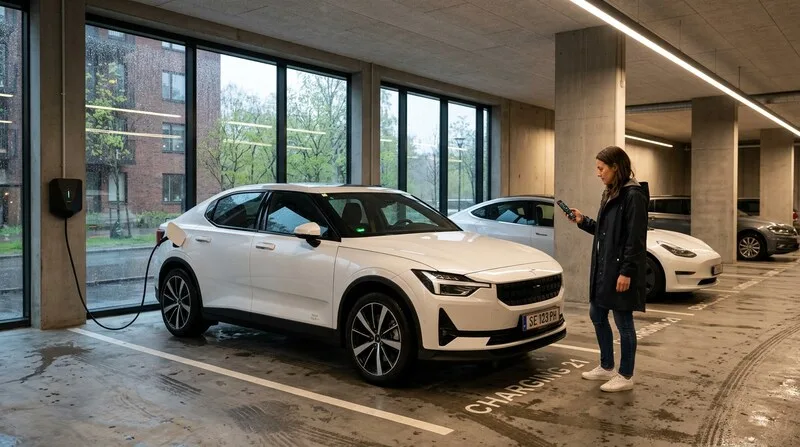
Solar surplus charging means the charger dynamically adjusts its output to match current solar production. Here's the technical flow:
- The solar inverter measures surplus: it calculates current home consumption against solar output. Whatever's left over (production minus household use) is available for the car.
- Charger and energy manager communicate: through SMA SunSpec, Modbus TCP, SEMP, EEBus, or a proprietary interface, the inverter tells the charger how much power is available.
- The charger adjusts output in real time: from a minimum of 6A (1.4 kW) up to 16A (3.7 kW) single-phase, or up to 32A (22 kW) three-phase.
- The car charges purely on solar: if output drops below the minimum threshold (usually 1.4 kW), charging pauses or falls back to grid power.
Worth knowing: three-phase charging (11 kW) allows finer control than single-phase (3.7 kW). Most systems adjust in 230W increments (1A per phase). The minimum practical solar system size for meaningful surplus charging is 5 kWp.
Smart chargers for solar integration: which fits your system?
Not every charger supports solar-surplus charging. These models cover the major inverter ecosystems:
| Charger | Power | Solar compatibility | Price (hardware) |
|---|---|---|---|
| go-e Charger Gemini | 11 / 22 kW | Any inverter via API (Fronius, SMA, Kostal, Huawei) | €499–699 |
| SMA EV Charger | 7.4 / 22 kW | Seamless with SMA Home Manager / Sunny Home Manager | €799–1,100 |
| KEBA P30 x-series | 11 / 22 kW | SMA SunSpec, Modbus TCP, Loxone | €650–900 |
| Fronius Wattpilot | 11 / 22 kW | Best integration with Fronius inverters | €699–899 |
| Mennekes AMTRON Charge | 11 kW | SEMP (SMA), EEBus | €600–850 |
| Wallbox Pulsar Max | 22 kW | myWallbox app, ECO-Smart mode | €549–749 |
Recommendation: already have a Fronius inverter? Get the Wattpilot. SMA customers should look at the SMA EV Charger or KEBA. Want to stay inverter-agnostic? The go-e Gemini is the most flexible option. More on installation: Home EV charger installation guide.
Bidirectional charging: sending power back to the house (V2H) and the grid (V2G)
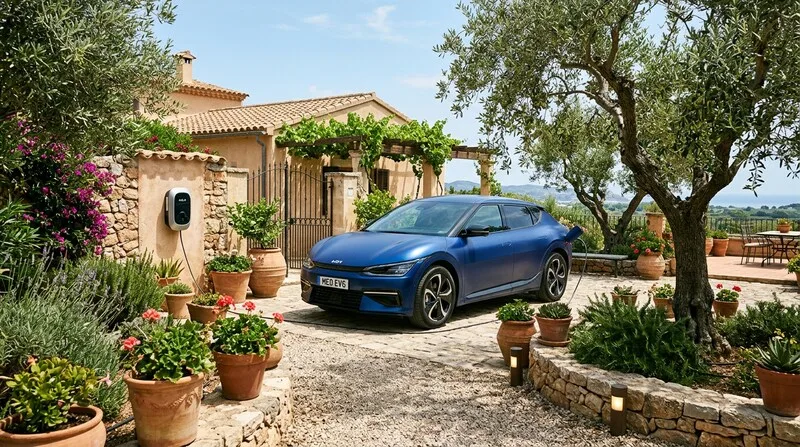
The next step beyond surplus charging is bidirectional charging: your EV can send power back into the house (V2H) or the grid (V2G) when needed, turning the car into a mobile battery.
- V2H: charge during the day with solar surplus, draw from the battery for household use in the evening. Potential savings: €300–600/year with a large EV battery (77+ kWh)
- V2G: utilities pay for stored power fed back during peak demand – still in the pilot phase in Germany
- Compatible vehicles (as of 2026): Nissan Leaf (CHAdeMO), Hyundai IONIQ 5/6 (V2L), Kia EV6 (V2L), BYD Atto 3, Genesis GV60
- Chargers for V2H: require a specialized inverter/charger system (e.g. Wallbox Quasar 2, SMA Tripower X)
Full details: Bidirectional charging (V2G/V2H) explained.
The economics: when does solar + a home charger pay off?
A concrete example for a typical single-family home with a 10 kWp solar system and one EV:
| Item | Without surplus charging | With surplus charging |
|---|---|---|
| Car charging cost/year (3,600 kWh) | €1,080 (€0.30/kWh) | ~€180 (10% still from grid) |
| Feed-in payment forgone | — | –€234 (3,240 kWh × €0.072) |
| Net savings per year | — | ~€666 |
| Extra cost for a smart charger | — | ~€200 (vs. a basic charger) |
| Payback period on that extra cost | — | < 4 months |
Bottom line: a smart charger pays for itself extremely fast once you have solar. See exactly how much energy your car needs per year with our EV energy consumption guide, and estimate charging times with the charging time calculator.
Funding: combining KfW 270 (solar) and KfW 442 (charger)
Both components qualify for government funding – and can be combined:
- KfW 270 – Renewable Energy: low-interest loans for solar systems, battery storage and heat pumps. Rates from 4.5% p.a. up to €50 million in loan volume (effectively unlimited for private homeowners). No grant, just a cheaper loan than a typical bank loan.
- KfW 442 – Solar Power for EVs: combines a solar system, a charger and home battery storage. Grants up to €9,600 possible. The charger must be at least 11 kW and smart (OCPP or direct grid control).
- State-level funding: Bavaria, NRW, Baden-Württemberg and other states offer additional €500–2,500 for solar+charger combos.
All funding info in one place: Home EV charger incentives 2026: KfW 442, states & employers.
Frequently asked questions
How big does my solar system need to be for meaningful surplus charging?
At least 5 kWp for meaningful self-consumption. With 10 kWp, you can cover 70–80% of an EV's charging needs in summer. In winter, solar output is low, so you'll be charging from the grid regardless.
Do I need home battery storage for solar + EV charging?
No, but it significantly increases self-consumption – especially if you're away during the day and charge the car at night. A 10 kWh battery costs €6,000–10,000 and pays for itself in 8–12 years. Using the EV itself as storage (V2H) is the cheaper long-term solution.
Which inverter works best with solar + a home charger?
SMA, Fronius and Kostal offer the broadest compatibility with smart chargers. Huawei's Sun2000 is affordable and works with the Huawei EMMA energy management system. For maximum flexibility, choose an inverter with SunSpec/Modbus support – that works with almost any smart charger.
Can I do surplus charging without solar panels?
No, surplus charging requires your own solar system. Without solar, you can still take advantage of cheap off-peak charging with a dynamic electricity rate (Tibber, Octopus and similar) – the charger automatically runs when wholesale electricity prices are lowest.
More on home charging: Home EV charger installation: costs, models, tips. Are you actually saving money with an EV? True cost of owning an EV 2026.