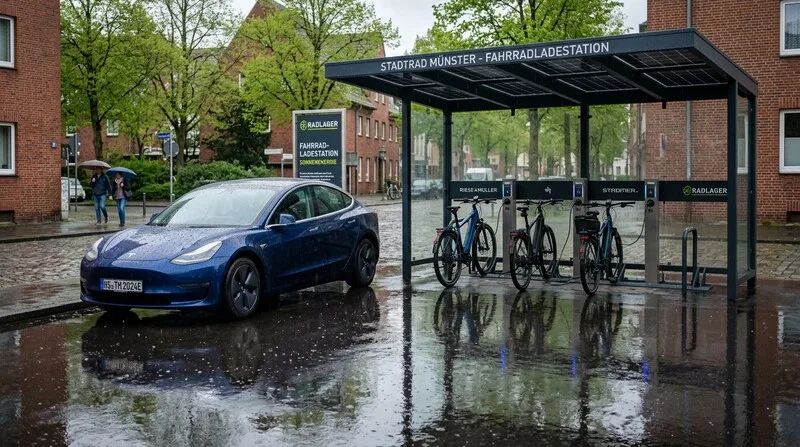
A tenant's right to a home charger: what's applied since 2020?
Germany's 2020 reform of the Condominium Act (WEG) introduced an important principle: tenants and unit owners have a legal right to have a charger installed (§554 BGB for tenants, §20 WEG for unit owners).
In practice, that means:
- Your landlord can't refuse outright
- They can set conditions (e.g. installation method, a certified electrician)
- You cover the installation cost yourself
- When you move out: removal at your own expense (or an agreement to leave it)
Important: this right only applies to your own parking spot (a garage, underground space, or dedicated outdoor spot). If you don't have a fixed spot, you don't have a claim to a charger in shared areas either.
How do I request a charger from my landlord?
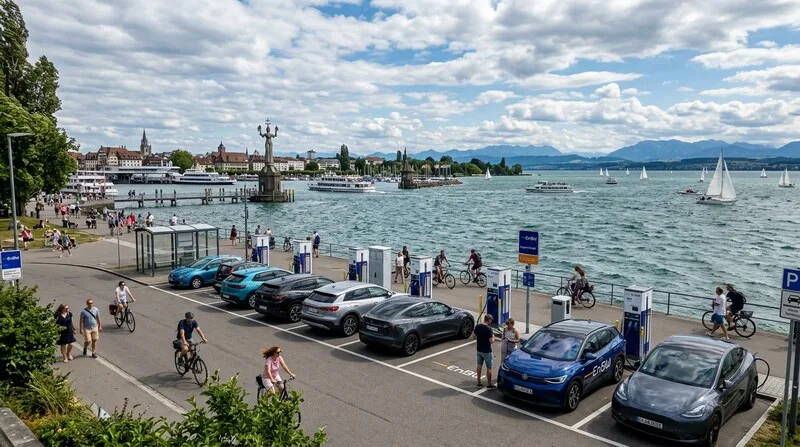
The process is formal – but doesn't have to be complicated:
- Submit a written request (email or letter with delivery confirmation): the charger model, an installation plan, and your electrician's name
- Your landlord has roughly 3 months to respond (not a hard legal deadline, but a reasonable benchmark)
- If refused: request a justification. A blanket refusal isn't allowed – only for a valid reason (structural impossibility, dangerous existing electrical setup)
- Find common ground: a conversation often works. Show that you're planning a clean, certified installation and covering the cost yourself
- As a last resort: tenant advocacy organizations and lawyers can help if the landlord still blocks it
Homeowner-association votes: when every owner needs to agree
In a building with multiple owners (a homeowner association, or WEG), things get more complex. Any individual owner can request a charger for their own spot – but structural changes to shared property (like running cable through a stairwell) require a vote of the association.
Since the 2020 reform:
- Individual owners can install a charger at their own risk and cost without a majority vote
- Shared solutions (a central charging system with billing) require a majority vote of the association
- The association can allocate costs across all owners if they collectively decide to install shared charging infrastructure
Tip: KfW 441 funding (up to 70% grant) applies specifically to homeowner-association solutions with intelligent load management – a good argument to bring to the vote. More: EV charging in apartment buildings.
Load management: why apartment buildings need it

A typical building's electrical connection delivers 63–100 amps total for every unit combined. If 10 residents charge simultaneously at 11 kW, that would need 110 kW – impossible for most building connections.
The fix: intelligent load management. A system dynamically distributes the available power across every active charger. It's a requirement for KfW 441 funding. Providers like Heidelberg Energy Control, go-e Controller or smartWB offer suitable systems.
Cost for a shared solution with 10 charging points and load management: roughly €15,000–30,000 without funding. With KfW 441: often under €10,000 out-of-pocket.
Alternatives: charging without a home charger
Not every renter has access to a parking spot, or gets a charger approved quickly. These alternatives work well:
| Alternative | Cost/kWh | Convenience | Best for |
|---|---|---|---|
| Nearby public charger | €0.35–0.55/kWh | Medium | City dwellers with short trips |
| Charging at work | Often free | High | Commuters with employer parking |
| Charging while shopping | Often free or cheap | Medium | City drivers, occasional use |
| Parking garage with chargers | €0.45–0.65/kWh | Medium | City-center residents |
| Household outlet | Your electricity rate (~€0.35/kWh) | Low (2.3 kW = very slow) | Emergency use only |
Find every public charging station near you: interactive charging map. Cheap alternatives: Free EV charging and Charging while shopping.
An honest check: who can make an EV work without home charging?
The honest answer: plenty of city drivers manage fine with a bit of planning. Most people in cities drive well under 25 miles a day. With a public AC charger a 5–10 minute walk away, plus charging while shopping, that covers 90% of trips.
It gets harder if you have:
- Over 50 miles of daily driving with no charging at work
- Little public charging infrastructure nearby
- A vehicle with limited range (under 155 miles WLTP)
Tip: use our charging time calculator to quickly work out whether public charging fits your routine. And: many employers help fund a home charger installation – it's worth asking (Germany's EV charger incentives).
Frequently asked questions
Can my landlord refuse a charger installation?
Not outright. Since §554 BGB (2020), German tenants have a right to have their request approved. The landlord can set conditions (certified electrician, specific models), but can't refuse without reason. A tenant advocacy group or lawyer can help with an unjustified refusal.
Who pays for the electricity used at a home charger as a renter?
You do, generally, through a dedicated meter or a sub-meter. Many landlords accept billing through an existing sub-meter. Modern apartment buildings increasingly use smart metering that tracks consumption per parking spot separately.
Do I have to remove the charger when I move out?
In principle, yes – you're expected to return the rental unit as you received it. In practice, many tenants agree with their landlord that the charger stays (sometimes with compensation for installation cost). Get that agreement in writing.
Is there funding for chargers in rental apartments?
There's no nationwide direct funding for individual chargers in rental units in 2026. If your landlord or homeowner association approves a shared solution, KfW 441 funding (up to 70% grant) can apply. Employers can also fund a charger tax-free (up to €1,000/year).
Plan the next step: EV charging in apartment buildings · Home EV charger incentives 2026 · Find your nearest charging station