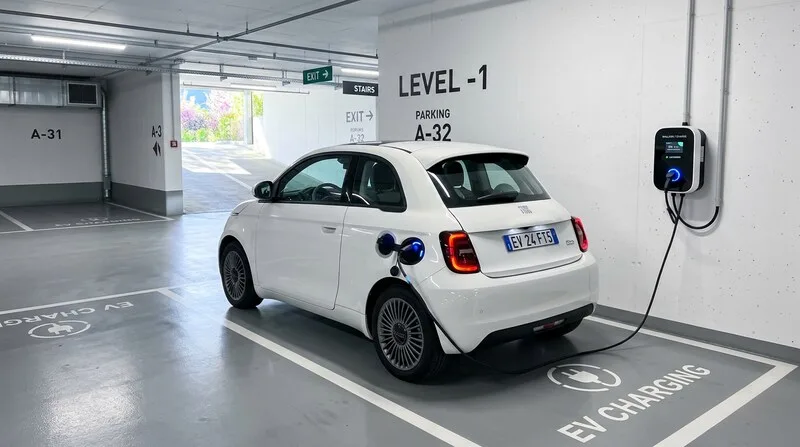
The legal right to a charger, in effect since 2020
Since December 1, 2020, German law guarantees tenants and unit owners a legal right to a charging point for EVs. It's codified in §20(2) of the German Condominium Act (WEG) and §554 of the Civil Code (BGB) for renters. A landlord or homeowner association can't refuse installation without a valid reason, but they do have to approve the specifics.
- Renters: have a right to structural modification (§554 BGB) – landlords can only refuse for legitimate reasons like heritage protection or genuine technical impossibility.
- Unit owners: have a right to approval from the homeowner association, which can only refuse for compelling reasons.
- Cost: generally falls on whoever requests the installation (the tenant or owner).
Note: the right covers one charger at your own parking spot. Installation still has to be done properly and can't compromise the building's structural safety.
The process: how tenants and owners get it done

Getting a charger installed in a shared building typically follows this path:
- Submit a written request to the landlord or property management, including technical details of the planned charger and its cost.
- Get approval – either a vote at the homeowner association meeting, or written landlord consent.
- Hire an electrician – load assessment, cable routing, meter installation. Always use a certified contractor.
- Register with the grid operator – required above roughly 12 kW.
- Apply for incentives before signing any contract – funding must be requested before work begins.
The technical challenge: underground garages
The biggest hurdle is usually power delivery: running a cable from the building's electrical room to an underground garage spot can mean 150–300 feet of cable. That costs money, and depending on the required capacity, real planning effort too.
| Component | Typical cost | Note |
|---|---|---|
| Charger (11 kW) | €400–800 | WiFi and app control recommended |
| Cable routing (underground garage) | €500–3,000 | Depends on distance and concrete work |
| Dedicated electricity meter | €200–500 | Needed for accurate billing |
| Load management system | €300–1,000 | Needed with multiple chargers |
| Total (1 charger) | €1,200–4,500 | Before any incentive funding |
Load management becomes essential once multiple residents want to charge at the same time: a dynamic system distributes the building's available power across every active charger, so the electrical connection never gets overloaded.
Incentives: up to €1,500 per charging point

Germany's KfW 442 program funds home chargers bundled with a solar installation and battery storage. For a standalone charger with no solar, there's currently no national grant – but state-level programs can help:
- Bavaria: Bavarian E-Mobility Program (up to €500)
- Baden-Württemberg: L-Bank funding programs
- North Rhine-Westphalia: progres.nrw (commercial buildings)
- Many local grid operators run their own incentive programs – always worth asking
Tip: even without national funding, installation costs in a shared building can often be claimed as a household service expense on German taxes – up to 20% of labor costs, capped at €1,200.
Multiple chargers: shared solution vs. individual installs
If several residents want to upgrade at once, planning it centrally pays off:
- Advantage: one round of cable work, shared electrical upgrade, lower cost per parking spot
- Billing: handled through smart-meter infrastructure or dedicated billing software
- Approval: a shared installation can be approved as routine building management, simplifying the vote
For new construction, the EU's Energy Performance of Buildings Directive requires all new multi-unit buildings to pre-install conduit for future chargers.
Billing: who pays for the electricity?
Three common billing models are used:
- Dedicated meter: direct billing with the electricity provider – simple and transparent
- Submetering: a sub-meter off the main building meter, billed monthly by property management
- Backend platform: a charging infrastructure operator handles billing through an app
Frequently asked questions
Can a landlord refuse a charger without a reason?
No. Since 2020, §554 BGB gives German tenants a legal right to one. A landlord can only refuse if installation is technically impossible, blocked by heritage protection rules, or would incur disproportionate costs.
Who pays for the installation?
Generally, whoever requests the charger (the tenant or unit owner). Exception: measures approved as a shared building project are funded collectively by the homeowner association.
What is load management, and do I actually need it?
Load management automatically distributes available grid capacity across multiple chargers. Once a building has 2–3 charging points, it's essential to avoid overloading the electrical connection. Budget an extra €300–1,000 for it.
Can a renter take the charger when they move out?
Generally, yes – tenants have the right to remove it, but can also be required to if the landlord insists. Some landlords will buy the charger from the tenant instead. Get this agreed in writing up front.
More on home charger installation for homeowners: Home EV charger installation guide · As a renter: Charging as a renter – rights and options · Find every charging station on the map