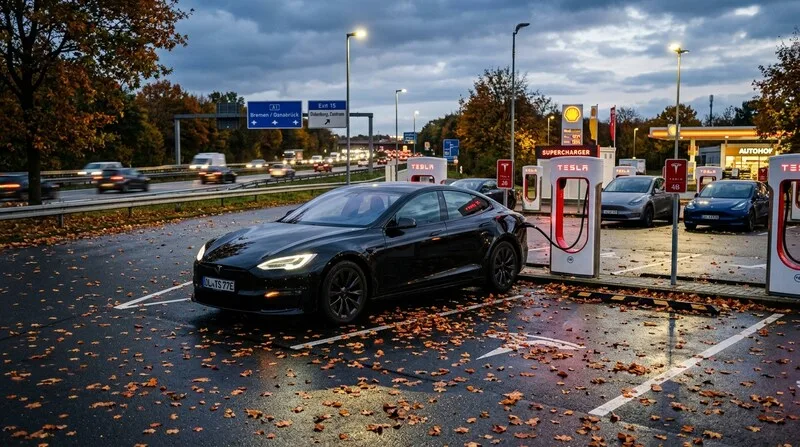
WLTP vs. real-world range: what's the difference?
Manufacturers quote range using the WLTP test cycle (Worldwide Harmonised Light Vehicle Test Procedure), a lab test run under ideal conditions. Real-world numbers come in noticeably lower, for a few clear reasons:
- Temperature: cold weather cuts battery capacity by 20–35%, heat by 10–15%
- Highway speed: 80 mph uses roughly double the energy of 50 mph
- Heating and AC: a continuous 1–3 kW draw
- Battery aging: roughly 10% less capacity after 5 years
Rule of thumb: real-world range ≈ 75–85% of the WLTP number in mixed driving, dropping to 60–70% in winter at highway speed. More: EV range 2026 – every factor explained.
Compact and mid-size EVs, 2026
| Model | Battery | WLTP | Real | Winter | Max charge |
|---|---|---|---|---|---|
| Tesla Model 3 LR | 75 kWh | 391 mi | ~325 mi | ~225 mi | 250 kW |
| VW ID.4 Pro | 77 kWh | 329 mi | ~260 mi | ~180 mi | 135 kW |
| Hyundai IONIQ 6 LR | 77 kWh | 381 mi | ~317 mi | ~225 mi | 233 kW |
| BMW i4 eDrive40 | 83 kWh | 367 mi | ~298 mi | ~205 mi | 205 kW |
| Kia EV6 GT-Line | 77 kWh | 313 mi | ~255 mi | ~180 mi | 233 kW |
| Skoda Enyaq 85 | 82 kWh | 348 mi | ~280 mi | ~193 mi | 135 kW |
| Renault Megane E-Tech 220 | 60 kWh | 280 mi | ~224 mi | ~155 mi | 130 kW |
| Tesla Model Y LR | 75 kWh | 331 mi | ~267 mi | ~186 mi | 250 kW |
SUVs and premium EVs, 2026
| Model | Battery | WLTP | Real | Winter | Max charge |
|---|---|---|---|---|---|
| Mercedes EQS 450+ | 108 kWh | 487 mi | ~385 mi | ~273 mi | 200 kW |
| Tesla Model S LR | 100 kWh | 439 mi | ~354 mi | ~249 mi | 250 kW |
| BMW iX xDrive50 | 111 kWh | 391 mi | ~317 mi | ~224 mi | 195 kW |
| Audi e-tron GT quattro | 93 kWh | 303 mi | ~242 mi | ~171 mi | 270 kW |
| Porsche Taycan 4S | 93 kWh | 323 mi | ~255 mi | ~177 mi | 270 kW |
| Hyundai IONIQ 5 LR | 77 kWh | 315 mi | ~252 mi | ~177 mi | 233 kW |
| Volkswagen ID.7 Pro S | 86 kWh | 441 mi | ~354 mi | ~249 mi | 175 kW |
| Volvo EX90 Twin Motor | 111 kWh | 360 mi | ~292 mi | ~205 mi | 250 kW |
Note: real-world figures assume mixed driving (70% rural/city, 30% highway) at 68°F. Winter figures assume 23°F with the heater running.
Affordable models with solid range

| Model | Battery | WLTP | Real | Price from |
|---|---|---|---|---|
| VW ID.3 Pro | 62 kWh | 265 mi | ~211 mi | €37,000 |
| Tesla Model 3 SR | 57 kWh | 305 mi | ~245 mi | €40,000 |
| Nissan Ariya 63 | 63 kWh | 250 mi | ~199 mi | €43,000 |
| BYD Atto 3 | 60 kWh | 261 mi | ~211 mi | €38,000 |
| MG4 EV 64 | 64 kWh | 270 mi | ~217 mi | €30,000 |
How much range do you actually need?
Most drivers cover well under 30 miles a day. Even a budget EV with 190 miles of real-world range easily covers a normal week – as long as you can charge at home. Only regular long-distance highway driving (190+ miles in a stretch) really justifies a model rated for 310+ miles WLTP.
- Commuters under 60 miles/day: a 40–60 kWh battery is plenty (VW ID.3, Tesla SR)
- Families, weekend trips: 60–80 kWh (VW ID.4, IONIQ 6, Tesla Model Y)
- High-mileage and road-trip drivers: 80+ kWh (Tesla Model 3 LR, Mercedes EQS, VW ID.7)
For long trips, plan your charging stops ahead of time. Use the charging map to find 150+ kW fast chargers along your route. More tips: Highway EV charging guide.
Range in winter – what changes?
In winter (below 41°F), most EVs lose 25–40% of their range. Why:
- Colder batteries deliver less energy and charge more slowly
- Cabin heating draws an extra 1.5–3 kW
- Denser cold air increases aerodynamic drag
Models with a heat pump (IONIQ 6, Tesla Model Y, VW ID.4) lose noticeably less range in winter than models with simple resistive heating. Details: EV range in cold weather.
Frequently asked questions
Which EV has the longest range in 2026?
By WLTP rating, the Mercedes EQS 450+ leads at 487 miles, followed by the VW ID.7 Pro S (441 miles) and Tesla Model S LR (439 miles). Realistically achievable range is around 375–385 miles for the EQS and roughly 354 miles for the ID.7.
How do I calculate real-world range?
Multiply the WLTP figure by a factor for your conditions: 0.80 for mixed driving in summer, 0.65 for highway driving, and 0.60 for winter highway driving. Example: a VW ID.4 rated at 329 miles WLTP × 0.80 = 263 miles realistic in summer.
Does range decrease over the years?
Yes, but slowly. Typical capacity loss is 2–3% per year. After 8 years, a battery usually retains around 80% of its original capacity. Manufacturers typically guarantee 70–80% after 8 years or 100,000 miles.
Is range anxiety still a real issue?
Not for daily driving – most drivers charge overnight at home and start each day with a full battery. On road trips, fast chargers are typically spaced every 20–30 miles on major highways. With 190+ miles of real-world range and a solid fast-charging network, range anxiety is largely a thing of the past.
Find charging stations for your route: charging map with 120,000+ charge points. All highway fast chargers: Highway EV charging guide. Which models have the best range? Best electric cars 2026. Total cost overview: True cost of owning an EV.