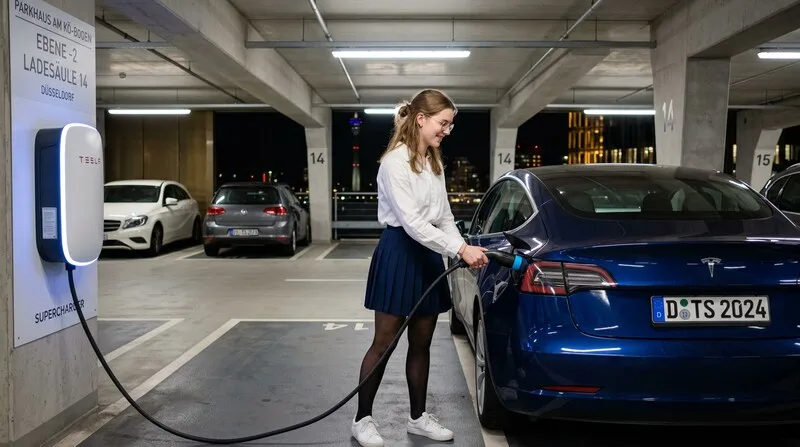
How DC Fast Charging Works
Unlike AC charging (which goes through the car's onboard charger), DC fast charging delivers power directly to the battery. The charger converts AC from the grid to DC before it enters the car – enabling much higher power levels.
Typical DC charging speeds:
- 50 kW: Older fast chargers, adds ~30 miles per 10 min
- 150 kW: Common high-speed chargers, adds ~80–100 miles per 10 min
- 250–350 kW: Ultra-fast (Tesla V3, Electrify America, Ionity), adds 100–200 miles per 10 min
Charge Time Calculator
Use our fast charging guide to estimate how long your specific car takes at any given power level. Key variables: battery capacity (kWh), current state of charge, and the charger's peak power.
The 20–80% Rule
Lithium-ion batteries charge fastest between 20% and 80% state of charge. Above 80%, the car's battery management system (BMS) throttles charging speed to protect the battery. On a highway trip, plan stops that bring you from ~10–20% to ~80% – this is the fastest and healthiest charging strategy.
Does Fast Charging Damage the Battery?
Occasional DC fast charging is fine for modern EVs. Daily fast charging above 80% can slightly accelerate degradation over 5–10 years. Most manufacturers (Tesla, VW, Hyundai) say regular use of their Supercharger/HPC networks does not void warranty. The main rule: don't charge to 100% at DC fast chargers unless necessary.
Top DC Fast Charging Networks 2026
| Network | Max Speed | Price (approx.) | Region |
|---|---|---|---|
| Tesla Supercharger V3 | 250 kW | $0.25–0.48/kWh | Global |
| Electrify America | 350 kW | $0.36–0.48/kWh | USA |
| Ionity | 350 kW | €0.35–0.79/kWh | Europe |
| EVgo | 350 kW | $0.27–0.45/kWh | USA |
| Fastned | 300 kW | €0.59–0.79/kWh | Europe |
| EnBW | 300 kW | €0.49–0.59/kWh | Germany |
Tips for Highway Charging
- Pre-condition the battery: Set a charging stop as navigation destination – most EVs will warm the battery to optimal temperature automatically.
- Arrive at 10–20%: Don't stop too early. The last 20% of each charge is slowest.
- Stop at 80%: Unless you need more range, stop at 80% and get back on the road. Charging from 80–100% takes as long as 20–80%.
- Use the app: Most networks have apps to start charging, track progress, and pay without a card.

Understanding the Charging Curve
Not all DC fast chargers deliver their advertised speed throughout the session. The charging curve shows how power varies with state of charge (SOC). Key patterns:
- Most EVs hit peak DC speed between 10–50% SOC
- Power tapers off above 50–60% to protect battery cells
- Above 80%, charging often drops to 30–50 kW regardless of station speed
- Best cars (Hyundai Ioniq 6, Tesla Model 3 LR) maintain high power up to 70–75% SOC
Practical implication: stop your fast-charging session at 80% and drive on. The next 20% costs almost as much time as the first 60%.
V2G and Bidirectional Charging
Vehicle-to-Grid (V2G) technology lets your EV battery feed power back into the home or grid. A handful of EVs already support this (Nissan Leaf, Ford F-150 Lightning, Hyundai Ioniq 5). Benefits:
- Power your home during an outage (V2H – Vehicle to Home)
- Sell excess energy back to the grid at peak pricing
- Reduce home electricity bills by 20–40% with a smart tariff
V2G requires a compatible bidirectional charger (e.g. SolarEdge, Wallbox Quasar) and a compatible vehicle. This technology will be standard in most new EVs by 2027–2028.
What Happens in Extreme Cold?
Cold weather dramatically affects DC fast charging speed. Below 15°C (59°F), lithium-ion cells become less conductive and the battery management system throttles incoming power to avoid damage. A 250 kW charger may deliver only 60–80 kW to a cold battery.
Solution – battery pre-conditioning: Set a DC fast charger as your navigation destination 20–30 minutes before arrival. The car will heat the battery to optimal temperature (25–35°C) using grid power while still plugged in or using traction battery energy while driving. This restores full fast-charging capability.
All Tesla models, Hyundai Ioniq 5/6, and most 2024+ EVs support automatic pre-conditioning. Check your car's settings or manual.
Frequently Asked Questions
How often can I DC fast charge without harming the battery?
Modern EVs handle regular fast charging well. Tesla, VW and Hyundai explicitly say their networks do not void battery warranty. The practical guideline: DC fast charge when you need speed; use Level 2 or home charging for daily top-ups. Avoid charging to 100% at DC chargers unless essential for range.
Is 350 kW actually available right now?
Yes – Electrify America, Ionity, and some EVgo stations offer 350 kW hardware. Currently only a few vehicles can accept this full power: Porsche Taycan (270 kW), Audi e-tron GT (270 kW), Hyundai Ioniq 6 (233 kW). Most EVs accept 100–200 kW maximum regardless of station speed.
Does sitting at a fast charger after reaching 80% cost more?
Most networks charge by the kWh – you only pay for energy delivered. However, some networks add an idle/overstay fee ($1–2/min) after your session ends but the car remains plugged in. Check the network's pricing before you leave the car.
See all charging networks and their station maps. Use the live charging map to find the nearest DC fast charger. Learn about charging costs in the USA and Europe.