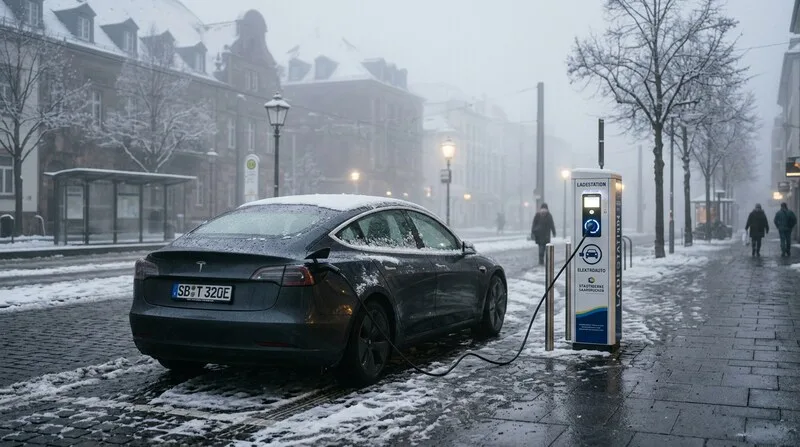
What is battery degradation? SoH explained simply
Every lithium-ion battery loses capacity over time – that's physically unavoidable. This process is called degradation, and the remaining capacity relative to new is called State of Health (SoH).
- SoH 100%: brand new – full range as advertised
- SoH 80%: typical after 90,000–125,000 miles or 8–10 years
- SoH under 70%: noticeable range loss, a warranty claim for most manufacturers
In practice, real-world studies (including Recurrent Auto's fleet data) show average degradation of just 1–2% per year under normal use. Many batteries still hold 85–90% SoH after 10 years – far better than early predictions suggested.
What matters more than mileage itself: three specific factors accelerate aging noticeably, covered in the next section.
How long does the battery really last? Data by model

Real-world degradation data from fleet analysis and community reporting (SoH at roughly 60,000 miles):
| Model | SoH at ~60,000 mi | Note |
|---|---|---|
| Tesla Model 3 LR | ~91–94% | Very effective thermal management |
| Hyundai IONIQ 5/6 | ~90–93% | 800V architecture, less heat generation |
| VW ID.4/ID.3 | ~88–92% | Solid, some heat buildup with fast-charging |
| BMW iX/i4 | ~89–92% | Good thermal management |
| Renault Zoe (older gen.) | ~82–87% | No active cooling (early versions) |
| Nissan Leaf (Leaf+) | ~83–88% | Air-cooled, more sensitive to heat |
Bottom line: modern EVs with active thermal management (liquid cooling) hold up significantly better than older models without it. Always check SoH on a used purchase: Buying a used EV – the battery check guide.
What actually harms the battery the most?
Three factors noticeably accelerate degradation:
1. Frequent fast charging above 150 kW
High-power DC charging generates heat inside the battery. Most vehicles actively cool it, but repeated high-power sessions without adequate cooldown time raise the degradation rate. One Stanford study (2022) found that daily 350 kW charging accelerated degradation by 10–15% versus AC charging. More: AC vs DC charging.
2. Staying at full or empty for long periods
Lithium batteries don't like extremes. Sitting at 100% state of charge stresses the cathode; sitting below 10% stresses the anode. The ideal daily range: 20–80%. Only charge to 100% right before a long trip.
3. Heat – the quiet battery killer
Temperatures above 104°F significantly accelerate chemical aging. Parking in direct sun, especially in summer, can cause lasting damage without active thermal management. Vehicles with a heat pump and active thermal management (Tesla, IONIQ, Mercedes EQ) hold up much better here.
7 tips for maximum battery lifespan

- Set a charge limit at 80% – plenty for daily driving, and the battery is under far less stress
- Don't discharge below 15–20% – deep discharges cause lasting damage
- Prefer AC charging – a home charger over daily DC fast charging
- Precondition before DC charging – protects the battery and boosts charging speed
- Avoid parking in extreme heat – shade or a parking garage when possible
- Install software updates – manufacturers regularly optimize charging strategies via OTA updates
- Charge to 100% before long trips – doing it occasionally is far less harmful than doing it daily
Follow these rules and you can expect 88–93% SoH after 10 years. On a car rated for 310 miles WLTP, that's still over 270 miles of real-world range. Winter driving: Optimizing range in cold weather.
Manufacturer warranties compared, 2026
Most manufacturers guarantee a battery warranty of 8 years or 100,000 miles (whichever comes first), with a minimum 70% SoH guarantee. Exceptions:
| Manufacturer | Warranty term | Min. SoH | Notable |
|---|---|---|---|
| Tesla | 8 yr/120,000 mi (LR) | 70% | Long Range gets a higher mileage cap |
| Hyundai/Kia | 8 yr/100,000 mi | 70% | — |
| VW/Audi/Porsche | 8 yr/100,000 mi | 70% | — |
| BMW | 8 yr/100,000 mi | 70% | — |
| Mercedes | 10 yr/155,000 mi | 70% | Industry-leading |
| Renault | 8 yr/100,000 mi | 66% | Lower SoH threshold |
Important: the warranty only applies to normal use (no modifications, no racing). A covered claim means a free battery replacement or capacity restoration from the manufacturer.
Weak or dead battery: what does replacement cost?
A battery replacement outside of warranty is the most expensive repair an EV can need. Current price ranges:
- Small battery (20–40 kWh): €4,000–8,000 (Renault Zoe, Fiat 500e)
- Mid-size battery (60–80 kWh): €8,000–15,000 (VW ID.4, BMW i4)
- Large battery (90–100+ kWh): €15,000–25,000 (Tesla Model S, Mercedes EQS)
Tip: used batteries from wrecked vehicles are significantly cheaper (30–50% discount) and a reasonable option when installed by a qualified shop. For used-EV buyers: a car with SoH under 75% and an expiring warranty should be priced well below the new-car list price minus a replacement, or skipped entirely.
Long-term outlook: battery prices drop roughly 10–15% a year. A €15,000 battery today will likely cost under €8,000 by 2030. Buy now and take care of it, and you'll probably never need to replace it.
Every EV cost factor: True cost of owning an EV 2026 · Maintenance costs compared · Find every charging station.
Frequently asked questions
Does an EV battery permanently lose capacity in winter?
No – the capacity loss in winter is mostly temporary and reversible. Cold batteries can temporarily deliver and accept less energy but recover fully at normal temperatures. Permanent damage comes from heat, not cold. Details: EV range in cold weather.
Is daily fast charging harmful?
Occasionally, no. Daily, yes. Fast-charging above 150 kW every single day measurably accelerates degradation. Recommendation: reserve DC fast charging for road trips or emergencies, and use AC charging at home for daily driving.
What does SoH (State of Health) mean?
SoH is the battery's current health as a percentage relative to new (100%). A SoH of 85% means the battery still stores 85% of its original energy. It can be checked with apps or through manufacturer service.
Should I charge to 80% or 100%?
For daily driving: 80% – it's gentler on the battery and enough for most trips. Before a long trip: 100% is fine, as long as the car sets off soon after (don't leave it fully charged and idle for days). Most manufacturers recommend an 80–90% daily charge limit.