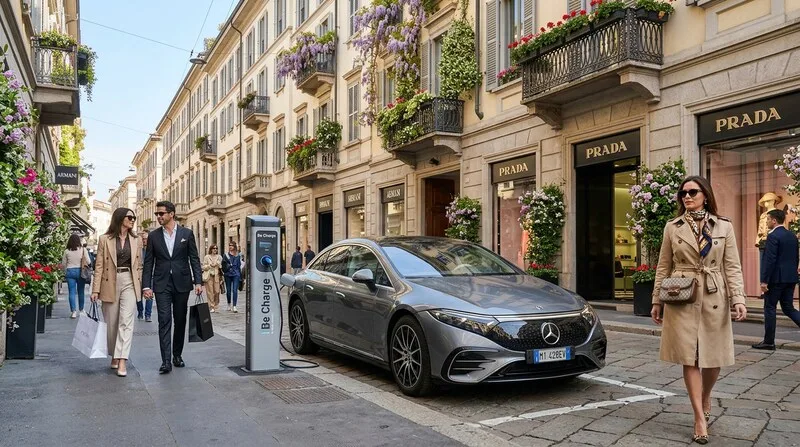
Why charging remains the last big hurdle for self-driving cars
Anyone who owns an electric vehicle today knows the routine: park, get out, pull the cable from the trunk, open the charging port, plug in, open an app, start the session. Small steps that add up in daily life, especially in underground garages, office parking lots, or apartment buildings without a dedicated home charger. While the conversation around autonomous driving usually centers on highway autopilot or robotaxis cruising through big cities, one part of the journey almost always stays untouched by automation: the act of charging itself. That is exactly where a technology first shown to a broad audience at CES 2024 comes in, and it shows just how far automation has crept into even the most mundane corner of electric mobility.
Automated valet parking is nothing new on its own; several automakers and suppliers already test it in parking structures. What is new here is pairing it with an automated charging process, where the vehicle does not just hunt for an open spot but drives itself straight to a charging station and gets plugged in without any human involvement. This fusion of SAE-level autonomous driving and everyday charging infrastructure is the real breakthrough that Bosch and Volkswagen subsidiary Cariad demonstrated at the show in Las Vegas. For EV owners who deal with charging their car every day, that is more than a technical footnote. It's a glimpse of how the most tedious part of owning an EV could disappear entirely within a few years.
Source: IoT World Today - Bosch Intros Automated Valet Parking, Charging at CES 2024
How Bosch and Cariad demonstrated automated charging at CES 2024
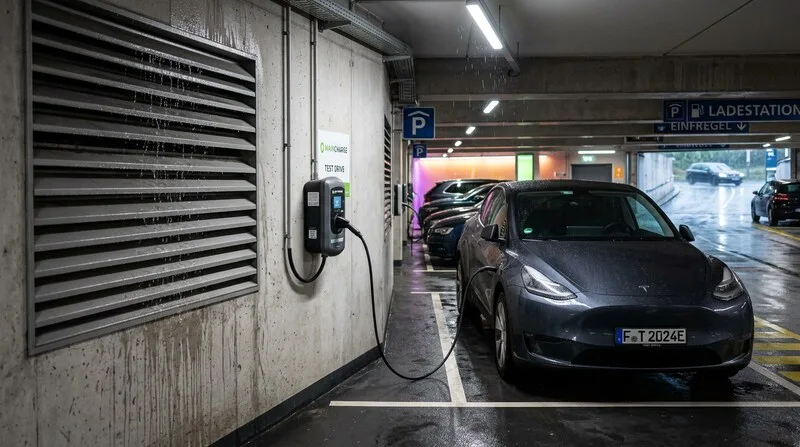
At its core, Bosch and Cariad presented a system called Automated Valet Charging at CES 2024. The basic idea: a driver pulls into a designated drop-off zone in a parking garage, gets out, and kicks off the rest of the process with a tap in a smartphone app. From that moment on, the car takes over completely, driving itself with no one behind the wheel, but only within a clearly defined garage area. Technically, that corresponds to SAE Level 4, a highly automated system that operates without human intervention, though strictly limited to a mapped operating zone rather than public roads.
From leaving the drop-off zone to plugging itself in
What stands out most is the sequence at the charging station itself. The car autonomously locates an open charger, pulls up with precision, and positions itself so a robotic arm can open the charging port and insert the cable, all without a person touching anything. The full process breaks down roughly into these steps:
- The driver parks in the drop-off zone and starts the process through the app.
- The vehicle drives itself into the garage, driverless, to find an open charging spot.
- A robotic arm automatically opens the car's charging port.
- The robot plugs in the cable, and charging begins on its own.
- Once the target charge level is reached, the robot unplugs the cable.
- The car drives itself to a regular parking space, freeing up the charger.
That last step matters just as much as the charging itself in everyday use. Anyone who has driven an EV knows the frustration of a fully charged car sitting at a charger for hours, blocking the spot for someone else. A system that automatically moves the car once it's done would go a long way toward easing that friction at public and semi-public charging stations.
Three separate test garages feeding into one combined system
It's also worth noting how the project came together technically: it builds on two test programs that were already running independently. Bosch has been piloting automated valet parking, without any charging function, for roughly a year at the P6 garage at Stuttgart Airport in Germany. Automated charging itself is tested separately at a Bosch development garage in Ludwigsburg. Cariad, meanwhile, runs its own driverless-parking trials at an employee parking garage in Ingolstadt. It took the CES presentation to show how these individual pieces, sensors for reading the parking garage environment, the software that controls the autonomous driving, and the new robotics at the charging station, can be strung together into one continuous process. Bosch executive Manuel Maier said in the announcement that automation plays a key role in the shift toward electric mobility, precisely because it removes the everyday friction that keeps many potential buyers from choosing an EV in the first place.
A reality check: prototype, not production
Industry coverage of the demo was largely positive but came with a clear caveat: so far, the technology only runs in three test garages under controlled conditions. For a system like this to matter in daily life, a much larger number of parking garages, underground lots, and charging hubs would need the same setup: sensors for driverless navigation, standardized drop-off zones, and robotics at every charging station. That's a significant infrastructure investment that won't happen overnight. Anyone weighing more conventional options today, like installing a charger at home, will need to be patient before their own car can find its way to a charging station on its own.
What autonomous charging could mean for EV owners in the long run
Even though Automated Valet Charging is still a prototype, it's worth thinking through what a wider rollout would actually change. The most obvious impact would show up in large parking structures and corporate campuses: instead of a limited number of chargers frequently tied up by cars that finished charging long ago but never moved, an operator could squeeze far more use out of the same chargers, since vehicles would automatically clear out once done. That would be a real improvement over today's system, where drivers usually have to remind themselves to move their car in time.
Over the long term, automated charging could also merge with other trends already gaining traction. One is bidirectional charging, or vehicle-to-grid technology, where EVs don't just draw power but can feed it back into the grid when needed. A car that drives itself to a charger could, in theory, also decide on its own exactly when to charge or discharge based on what makes the most sense for the grid at that moment. Another is wireless charging, where the robotic arm could eventually disappear altogether because the car simply parks over a charging pad embedded in the floor. Combined with automated valet charging, both technologies point toward a future where charging becomes something drivers never even have to think about.
Why fleets and shared vehicles stand to benefit most
The advantage is even bigger for vehicles that aren't tied to one owner. Robotaxi fleets, including services like Waymo's, need to top up between rides regularly, ideally without sitting idle for long stretches or requiring staff to manage the process. A system that sends vehicles to the nearest open charger, plugs them in, and returns them to service on its own is far more valuable economically for a fleet operator than for a private owner with a single car. It's no surprise that suppliers like Bosch and automakers like Cariad, both deeply embedded in the auto industry, are leading the charge here, especially as other automakers push similar automation efforts at a comparable pace.
For a system like this to scale, though, the vehicle needs to communicate not just with itself but with its surroundings, spotting open chargers in real time or coordinating charging power with the local grid operator. That's the job of V2X communication, the constant exchange of data between the vehicle, the infrastructure, and the grid. Without that kind of connectivity, automated charging stays a one-off feature confined to individual garages. With it, it becomes a building block of a much larger, intelligently managed charging network.
What still needs to happen before this reaches everyday drivers
Before Automated Valet Charging becomes standard in parking garages, several things need to fall into place:
- Widespread sensors and mapping in garages to support driverless navigation.
- Standardized drop-off zones where drivers can safely hand their car over to the system.
- Robotic hardware at charging stations that works across different car models and port designs.
- Regulatory clarity for driverless operation on private and semi-public property.
- Financial incentives for garage operators to invest in the added equipment.
- Driver confidence in letting their car operate entirely unsupervised.
That list explains why Bosch and Cariad deliberately started with confined test environments like an airport garage or an employee lot: it lets them get the infrastructure, the rules, and driver behavior under control before any wider rollout makes sense. A gradual introduction is the more realistic path, starting with corporate garages, airports, and large fleet depots, and only reaching public parking structures or residential buildings once the technology matures and gets cheaper.
For EV owners today, none of this changes the daily routine just yet. Anyone looking for practical answers on charging will still find them in more conventional resources comparing fast charging to regular charging or explaining the different connector types out there. But Automated Valet Charging already offers a clear signal of where the combination of autonomous driving and electric mobility is heading in the coming years: away from manual steps, toward a car that manages its own energy needs entirely on its own.
Additional Video
While the first video shows the valet-parking side of driving the car to a bay, this Rocsys video zooms in on the robotic plug-in itself, revealing the computer-vision-guided hands-free connector that actually makes autonomous charging work in practice.
Source: ROCSYS – ROCSYS | Hands-free charging for cars in Automated Valet Parking solutions
Frequently Asked Questions
What exactly is Automated Valet Charging?
It's a system developed by Bosch and Cariad where an electric car drives itself to an open charging spot after the driver gets out, gets plugged in automatically by a robotic arm, and then parks itself in a regular space once charging is finished.
Can I use this technology in my EV today?
No. The system is currently only being tested in three garages in Germany: one in Ludwigsburg for automated charging, and separate ones in Ingolstadt and at Stuttgart Airport for automated parking. There's no production-ready, publicly available version yet.
What level of automation does this driverless parking and charging use?
It runs at SAE Level 4, meaning the car drives itself within a clearly defined area like a parking garage, not the fully autonomous Level 5 driving that would apply anywhere on public roads.
Why is this being tested in parking garages instead of on public roads?
Parking garages are far easier to control, both technically and legally, than public streets. Fixed layouts, known routes, and low speeds significantly reduce the complexity the driverless system has to handle.