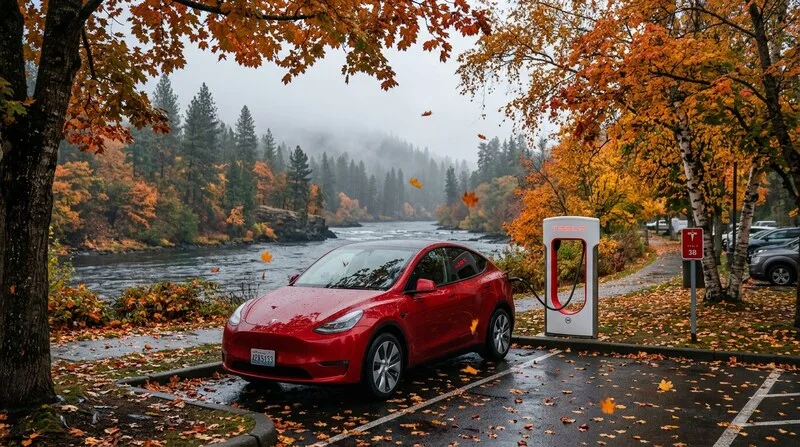
Why electric cars are learning to see for themselves
Buy an electric car today and you almost automatically get a vehicle loaded with a growing list of driver-assistance features: lane-keeping assist, adaptive cruise control, automatic emergency braking, and in some cases early Level 2 or Level 3 capability. These systems are the first rung on the ladder toward true autonomy, as laid out in the SAE levels of autonomous driving, and every one of them is built on the same underlying question: how does a car perceive its environment reliably enough that a machine, rather than a human, can make the driving decisions?
The answer lies in a combination of sensor technologies, each with its own strengths and blind spots. For EV owners, this isn't just an abstract engineering debate. Most modern electric vehicles from European and Asian automakers already rely on a mix of cameras and radar, while Tesla has gone the other way, dropping radar entirely in favor of a camera-only system, and LiDAR sensors are becoming production-ready as costs keep falling. If you want to understand why some cars brake more reliably in fog than others, or why a software update can suddenly unlock a new feature, it helps to know how these sensors actually work under the hood. That's exactly what a widely watched educational video from TED-Ed lays out, and we've broken it down below with some additional context.
Source: TED-Ed – How do self-driving cars "see"? - Sajan Saini
How LiDAR, radar, and cameras capture the road ahead
The video makes its point with a simple but striking scenario: a car driving down a dark country road at night, where three separate hazards appear within a split second of each other. To respond correctly, the car has to judge distance, speed, and object type almost simultaneously. That's a job split across three fundamentally different sensor types.
LiDAR: laser pulses and the 3D point cloud
LiDAR stands for Light Detection and Ranging, and it works on a straightforward physical principle: the sensor fires extremely short infrared laser pulses, invisible to the human eye, and measures precisely how long the light takes to bounce back off an object. Because the speed of light is constant, this time-of-flight measurement produces very accurate distance readings.
A single laser pulse only gives you one data point. But modern LiDAR units fire millions of these pulses per second in different directions, and the resulting flood of data builds a three-dimensional point cloud of the entire surroundings, detailed enough, according to TED-Ed, to pick out something as small as a shirt button on a pedestrian across the street. Another key advantage: since LiDAR generates its own light, it works reliably in complete darkness, no streetlights or ambient light required.
- Extremely precise depth and shape detection through time-of-flight measurement
- Builds a dense 3D point cloud of the vehicle's entire surroundings
- Works independently of ambient light, so it performs reliably at night
- Picks up fine details like the outlines and contours of objects
- Historically expensive and bulky, but increasingly practical as components shrink
Radar: dependable in rain, fog, and darkness
While LiDAR relies on light, radar uses radio waves, and that physical difference makes radar especially resistant to bad weather. Rain, fog, and snow, exactly the conditions where cameras and even LiDAR can struggle, barely affect radar signals. Radar also delivers very precise speed readings, since it measures the frequency shift of reflected waves, the same principle used in traffic speed enforcement.
That's why radar has been the backbone of features like adaptive cruise control and automatic emergency braking in nearly every modern car for years. The trade-off is resolution: radar produces a much coarser spatial picture than LiDAR and struggles to distinguish fine contours.
Camera: color, context, and its limits
The third sensor type, the camera, provides something neither LiDAR nor radar can: color and contextual information. Only a camera can read a red traffic light, a speed limit sign, or a white lane marking, details that are essential for interpreting traffic rules. The catch is physics: a camera doesn't measure distance directly, it has to estimate it from two-dimensional image data, which is inherently more error-prone than a direct time-of-flight measurement.
It's exactly this mix of complementary strengths and weaknesses that explains why most automakers combine multiple sensor types rather than betting on a single one, a principle covered in more depth in our guide to sensor fusion in self-driving cars. Tesla remains the industry's most visible exception, betting on cameras alone, a strategy that's still debated among engineers.
Why no single sensor is ever enough on its own
The TED-Ed video sums it up well: only the combination of LiDAR for depth and shape, radar for speed and weather resilience, and cameras for color and context produces the complete, and crucially redundant, picture of the surroundings that a car needs to make autonomous decisions. Redundancy here means that if one sensor fails or underperforms in certain conditions, the other two can fill the gap. Inside the car, that heavy lifting is handled by systems that merge these separate data streams in real time using artificial intelligence and machine learning.
Where sensor technology and self-driving cars are headed next
The integrated photonic chips mentioned in the video, sometimes called light-manipulating devices, are one of the most exciting trends of the next few years. They shrink laser and sensor hardware down to chip scale, making LiDAR systems smaller, cheaper, and far easier to integrate. What started a few years ago as a bulky, spinning unit bolted to a car's roof is increasingly disappearing into bumpers, grilles, and rooflines. This miniaturization is a key reason systems like Mercedes' Drive Pilot Level 3 system and robotaxi fleets such as Waymo can eventually become cheaper to scale, even though automakers like Mercedes have temporarily paused parts of their Level 3 rollout in early 2026 due to high costs and LiDAR supply constraints.
What this means for EV drivers
This sensor evolution matters to EV owners for several reasons. First, many of today's driver-assistance features are technically early versions of fully autonomous systems and keep getting expanded through over-the-air software updates. Second, the question of how safe self-driving cars really are hinges directly on how well these sensors hold up in tough real-world weather, whether that's heavy rain in the Pacific Northwest, fog on a German autobahn, or a snowy winter commute. Third, the tight technical link between autonomous driving and electric propulsion is no coincidence, something we cover in detail in our piece on why self-driving cars are almost always electric.
Where sensors and charging infrastructure meet
One angle we find especially interesting on Chargemap24: the same sensor stack that steers a car through traffic will, before long, also let a vehicle find an open charging stall and dock with it on its own. If that future interests you, we go deeper on it in our article on autonomous valet charging. Until that becomes mainstream, plugging in manually remains everyday reality for most EV owners, which is why it's worth bookmarking our complete guide to EV fast charging to make sense of charging times, connector types, and pricing.
Here's a quick summary of where this technology is headed over the next few years:
- LiDAR keeps shrinking and getting cheaper thanks to photonic chips
- Radar resolution improves, narrowing the detail gap with LiDAR
- Camera systems benefit from increasingly capable AI for object recognition
- Sensor-fusion software becomes the real competitive edge between automakers
- Falling costs push higher automation levels into mainstream, mid-priced vehicles
Taken together, this progress shows that the road to higher levels of automation isn't one single technological breakthrough, but the sum of many smaller advances in sensors, computing efficiency, and software. For anyone shopping for an EV, it's worth paying attention to these details, because they determine which systems will actually work reliably in the coming model years and which ones remain marketing promises for now.
Additional Video
For a real-world look beyond the theory, this official Waymo video shows how its fleet actually fuses LiDAR, radar, and camera data live on public roads to sense, solve, and navigate complex traffic situations.
Source: Waymo – Sense, Solve, and Go: The Magic of the Waymo Driver
Frequently Asked Questions
What's the main difference between LiDAR and radar?
LiDAR uses infrared laser pulses to deliver very precise depth and shape data, but it can struggle in heavy rain or fog. Radar uses radio waves, making it far more resilient in bad weather and especially good at measuring speed, though its spatial resolution is coarser.
Why isn't a camera alone enough for self-driving cars?
A camera provides essential color and context, like reading traffic lights or road signs, but it can't measure distance directly. Without LiDAR or radar backing it up, there's no reliable, weather-independent way to judge how far away objects are.
Does LiDAR work at night or in complete darkness?
Yes. Because LiDAR generates its own infrared light instead of relying on ambient light, it performs reliably even in total darkness, unlike traditional camera systems.
Which electric vehicles already use LiDAR sensors today?
As costs fall and photonic chips shrink the hardware, more automakers are adding LiDAR, particularly in vehicles with Level 3 features like Mercedes' Drive Pilot and in robotaxi fleets such as Waymo. Mainstream driver-assistance systems still lean primarily on radar and cameras.