Step 1: figure out what you actually need
The biggest mistake when buying an EV: buying way more range than you need out of anxiety. Most drivers cover well under 30 miles a day – a car with 190 miles of range comfortably handles 99% of everyday situations. Start by asking yourself:
- Daily distance: how far do you drive on an average day? (commute × 2)
- Home charging: do you have a garage or driveway with power access? Can you install a charger?
- Long trips: how often do you drive 300+ miles in one go? (for most people: rarely)
- Parking situation: your own home, a shared underground garage, or street parking?
- Budget: purchase price, or a monthly lease payment?
Rules of thumb:
- City car, under 60 miles/day → a 40–50 kWh battery is enough (Fiat 500e, Peugeot e-208, Dacia Spring)
- Commuter, under 95 miles/day → 60–70 kWh (VW ID.3, Renault Megane, Mini Aceman)
- High-mileage and road-trip driver → 75+ kWh (Tesla Model 3, IONIQ 6, BMW i4, Audi Q4)
The most important buying criteria, in detail
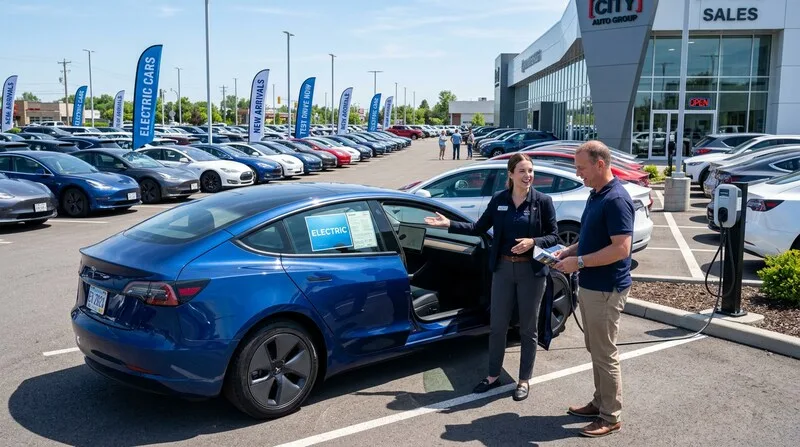
Beyond range, there are factors that are commonly underrated:
| Criterion | What it means | What to look for |
|---|---|---|
| Max. DC charging power | How fast the car charges at fast chargers | At least 100 kW for quick stops. 150+ kW is ideal for road trips |
| Battery warranty | Manufacturer guarantee on battery capacity | At least 8 years/100,000 miles, at least 70% capacity. VW/BMW: 8yr/100k mi, Tesla: 8yr/150k mi |
| Heat pump | Efficient heating – saves 20–30% winter range | Always check if it's standard or optional. IONIQ 6 and the VW ID lineup: standard or optional |
| Battery chemistry | LFP batteries last longer, NMC is more energy-dense | LFP (Tesla SR, BYD): charging to 100% daily is fine. NMC: better to keep it at 80% |
| Charging network access | Which networks can the car actually use? | Tesla owners: Supercharger access. CCS compatibility = every European fast charger |
| Software and OTA updates | Does the car keep improving over time? | Tesla, Hyundai/Kia's 800V platform and Polestar have the strongest OTA-update track record |
| Towing capacity | Matters for campers, trailers, boats | Many EVs have zero official tow rating. Tesla Model X, Audi Q8 e-tron: up to 5,500 lbs |
Model recommendations 2026: the best EVs by segment
Based on reliability, charging network access, battery warranty and value:
| Segment | Pick | Battery / range | Max DC | Price from |
|---|---|---|---|---|
| Cheapest city car | Dacia Spring | 26 kWh / 137 mi | 30 kW | €16,900 |
| Premium city car | Fiat 500e | 42 kWh / 199 mi | 85 kW | €26,990 |
| Compact | VW ID.3 Pro | 58 kWh / 267 mi | 170 kW | €36,995 |
| Efficiency champion | Hyundai IONIQ 6 | 77 kWh / 381 mi | 240 kW | €43,900 |
| Road trips + fast charging | Tesla Model 3 LR | 70 kWh / 391 mi | 250 kW | €45,990 |
| Compact SUV | VW ID.4 Pro | 77 kWh / 331 mi | 175 kW | €44,995 |
| Mid-size sedan | BMW i4 eDrive35 | 70 kWh / 367 mi | 210 kW | €51,900 |
| Best-kept budget secret | MG4 | 64 kWh / 270 mi | 140 kW | €27,990 |
Compare every model by range: EV range table 2026. Cost details: EV vs. gas car total cost comparison.
Buying vs. leasing vs. financing: what's the best option?

Three paths to getting an EV:
- Cash purchase: cheapest over the long run, no interest cost. Ties up capital. Best if: you have the cash and plan to keep the car 6+ years.
- Financing: a monthly payment, and you own the car. Watch the interest rate (roughly 3–6% p.a.). Better than leasing if: you're keeping the car a long time and want unlimited mileage.
- Leasing: a lower monthly payment, no ownership, resale-value risk sits with the leasing company. Especially attractive for business use (tax deduction plus the 0.25% rule). Details: EV leasing guide 2026.
Buying checklist: what to check at the dealer
- Test drive on the highway: don't just test it in city traffic. Real-world consumption shows up at 80 mph.
- Check the live range estimate: what does the car show at its current charge level? Does it line up with the official numbers?
- Test the charge port: try both AC and DC charging if the dealer can arrange it. Check cable compatibility.
- Battery health on used cars: always get the state of health (SoH) checked – it should be above 85%.
- Read the warranty documents: get the battery warranty confirmed in writing. When does it expire (mileage cap? charge cycles?)
- Software updates: can the dealer guarantee over-the-air (OTA) updates? How long is software support provided?
- Home charger advice: does the dealer ask about your home charging situation? That's a good sign of quality service. For installation: Home EV charger installation guide.
- Get insurance quotes: EVs are often pricier to insure (battery repair costs). Get 3 quotes before you buy.
Frequently asked questions
How long does an EV battery actually last?
Modern batteries last 10–15 years or 90,000–185,000 miles while retaining 70–80% of original capacity. Manufacturer warranties typically cover 8 years/100,000 miles at a minimum of 70% capacity. Tips: charge to 80% daily, avoid DC fast-charging to 100% routinely, and avoid extreme temperatures where possible.
Can I buy an EV without a home charger?
Yes, but it's significantly less convenient. On a standard wall outlet (2.3 kW), a full charge takes 20–30 hours. For most EV drivers, a home charger (11 kW, 6 hours) is an important comfort feature. Without a driveway or dedicated spot, plan on regular public charging instead.
When does a used EV make sense?
Used EVs under 3 years old and under 37,000 miles are often a great deal, since first-year depreciation runs 15–25%. Check battery condition (SoH above 85%), remaining battery warranty, and current software. Models from the 2022+ generation have noticeably better charging systems than older vehicles.
What's the cheapest EV available?
The cheapest new EV is the Dacia Spring, from roughly €16,900 (2026). It's fine for city driving up to about 95 miles a day. The cheapest EV with genuinely comfortable commuter range is the MG4, from roughly €27,990. Leasing tips: EV leasing guide.
Next steps after buying: Install a home charger · Cheap electricity rates for EV charging · Find your nearest charging station.