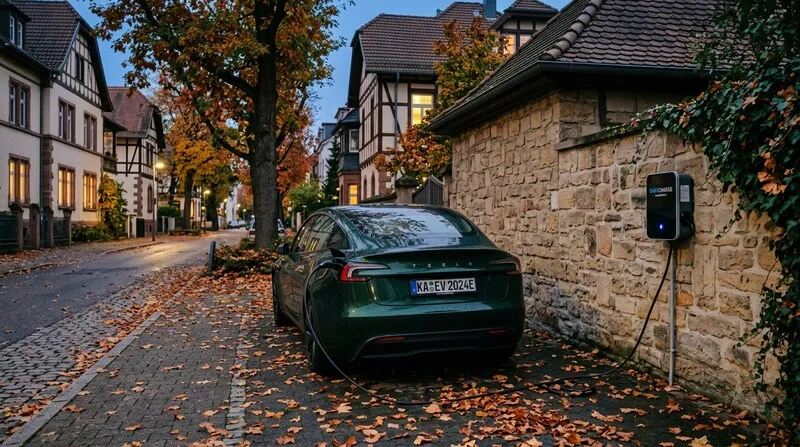
Why charging infrastructure mattered in the 2025 campaign
The abrupt end of Germany's national EV purchase bonus in November 2023 left a deep mark: new EV registrations fell more than 25% in 2024. At the same time, the public charging network kept growing, from roughly 85,000 to 100,000 charge points. The political question was: how should funding, expansion, and regulation be shaped so EV adoption in Germany doesn't stall?
Our interactive charging map shows the current state of the German charging network in real time, with over 38,000 German stations.
Where the major parties stood on charging infrastructure
| Party | EV incentives | Charging network expansion | Tax policy |
|---|---|---|---|
| CDU/CSU | Technology-neutral, no purchase bonus | Deregulation, market-driven | Keep the 0.25% rule |
| SPD | New purchase bonus, €500–4,000 | State investment in fast-charging network | Expand company-vehicle rules |
| Greens | Income-based bonus | Mandatory chargers at gas stations | Carbon price as a tax lever |
| FDP | No state purchase bonus | Cut red tape | Lower the energy tax |
CDU/CSU: market forces over subsidies
The CDU/CSU opposed reviving the purchase bonus, favoring technology-neutral policy that treats EVs, hydrogen, and hybrids equally. On charging expansion, the focus was cutting red tape: shortening permitting for new chargers to under six months. The tax advantage for electric company cars (the 0.25% rule) was to stay in place.
SPD: a new purchase bonus and a fast-charging network
The SPD wanted to bring back the purchase bonus, scaled by income, up to €4,000 for lower earners. Alongside that, a state-funded fast-charging network was meant to close regional gaps, particularly in rural states with sparse charger density.
Greens: mandates and a carbon price
The Greens pushed for binding requirements: gas stations above a minimum size would be required to install chargers. An income-based bonus was meant to make EVs accessible to broader income groups. A carbon price was proposed as the central market-driven lever to accelerate the shift to EVs.
What actually got passed after the election?
The 2025 coalition agreement between CDU/CSU and SPD set these key points:
- KfW home charger funding: reinstated funding for private home chargers (for homeowners)
- The 0.25% company-car rule: extended through 2030 without restriction
- EU charging infrastructure regulation (AFIR): implemented, requiring fast chargers every 40 miles on highways
- No purchase bonus: the focus shifted to infrastructure rather than vehicle subsidies
- Faster permitting: a target of under 6 months for grid connections for new chargers
Regional differences: charging networks by state
Charging infrastructure is distributed very unevenly by region, a direct result of political investment decisions at the state level:
| State | Charge points | Per 100,000 residents | Fast-charger share |
|---|---|---|---|
| Bavaria | ~18,000 | ~135 | 14% |
| North Rhine-Westphalia | ~15,500 | ~87 | 11% |
| Baden-Württemberg | ~12,000 | ~107 | 13% |
| Saxony | ~3,200 | ~78 | 16% |
| Mecklenburg-Vorpommern | ~1,800 | ~111 | 18% |
The major networks and their political context
Expansion of the big charging networks is only partly driven by policy. Private operators like EnBW, Ionity and Tesla drive most of it themselves. Still, policy has a direct influence:
- EnBW HyperNetwork: benefited from KfW funding loans for rapid expansion
- Ionity: EU-funded through AFIR resources for cross-border corridors
- Tesla Supercharger: independent of state programs, but indirectly favored by the 0.25% company-car rule
- Municipal networks: heavily dependent on state funding and local budgets
Outlook for 2026: what's next?
The three biggest levers shaping Germany's charging network going forward:
- EU AFIR implementation: mandatory fast chargers every 40 miles on highways since 2025
- Reinstated KfW home charger funding: should meaningfully raise home-charging adoption
- Faster grid connections: currently 18–24 months, with a target of 6 months to accelerate expansion